

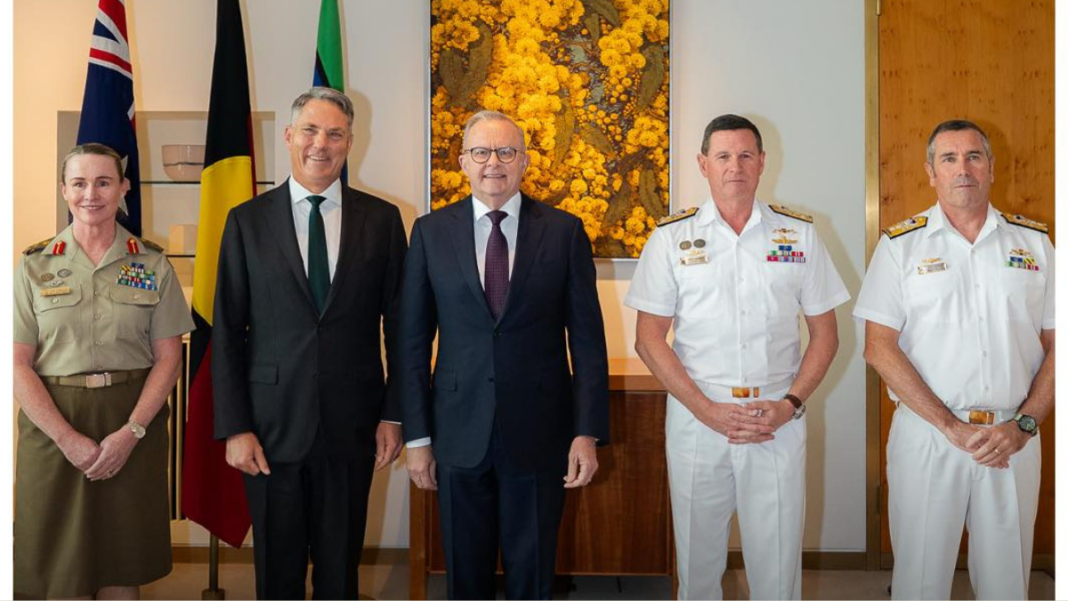
Australia is set for a major defence leadership transition from July, with the Albanese government recommending Vice Admiral Mark Hammond as the next Chief of the Defence Force, Lieutenant General Susan Coyle as the next Chief of Army, and Rear Admiral Matthew Buckley as the next Chief of Navy.
The appointments are subject to the Governor-General’s approval and will be presented to the Federal Executive Council.
The reshuffle will also mark the retirement of Chief of the Defence Force Admiral David Johnston and Chief of Army Lieutenant General Simon Stuart, with the government publicly thanking both men for decades of service. Admiral Johnston has served in the ADF for more than 48 years, while Stuart has been credited with helping prepare the Army for the changes flowing from the 2024 National Defence Strategy.
Prime Minister Anthony Albanese said the new appointments came at a critical time for Australia’s security and praised the ADF’s role in protecting the country.
“The Australian Defence Force is tireless in its efforts to keep Australians safe,” he said.
“From July we will have the first ever female Chief of Army in the Australian Army’s 125 year history.
Hammond, who has led the Navy since 2022, brings about 40 years of service to the top Defence role. The government says his background spans service in frigates, extensive submarine experience, command of the Australian Fleet and leadership through key capability programs, including Australia’s AUKUS nuclear-powered submarine pathway and the future surface combatant fleet.
Marles said the senior appointments would help guide the force through a consequential period, adding that each would continue to make “an enormous contribution” to Australia’s safety and security.
“I would also like to personally thank Lieutenant General Simon Stuart for his contributions to the Australian Army at such a consequential time, and wish him and his family all the best as he retires.”
Coyle’s elevation is the headline-making appointment. She began her career as an Army Reserve soldier in 1987 and has since held senior roles across tactical, operational and strategic command, including Head Information Warfare, Commander Forces Command, Commander Joint Task Force 633, Commander 6th Brigade, Commander Task Group Afghanistan and Commanding Officer 17th Signal Regiment.
She is currently Chief of Joint Capabilities and will now become the first woman to command the Australian Army.
Buckley, meanwhile, will take over as Chief of Navy on promotion. A submariner who has served in both Oberon and Collins class boats, he has commanded HMAS Collins and the Submarine Force, and previously led nuclear submarine capability work at the Australian Submarine Agency before becoming Deputy Chief of Navy in January 2025.
The government says that experience puts him in a strong position to lead the Navy through a period of major transition in the Indo-Pacific.
In thanking the outgoing leaders, Marles said Johnston had led the ADF over the past two years “with enormous impact”, including through Defence’s response to the Royal Commission into Defence and Veteran Suicide, AUKUS implementation and broader force transformation. He also praised Stuart’s service during what he described as a consequential time for the Army.
For the Albanese government, the appointments do more than fill senior vacancies. They place three leaders with deep operational and strategic experience at the centre of Australia’s next phase of defence planning, at a time when Canberra is sharpening its focus on deterrence, capability delivery and long-term military preparedness.
Support our Journalism
No-nonsense journalism. No paywalls. Whether you’re in Australia, the UK, Canada, the USA, or India, you can support The Australia Today by taking a paid subscription via Patreon or donating via PayPal — and help keep honest, fearless journalism alive.
