

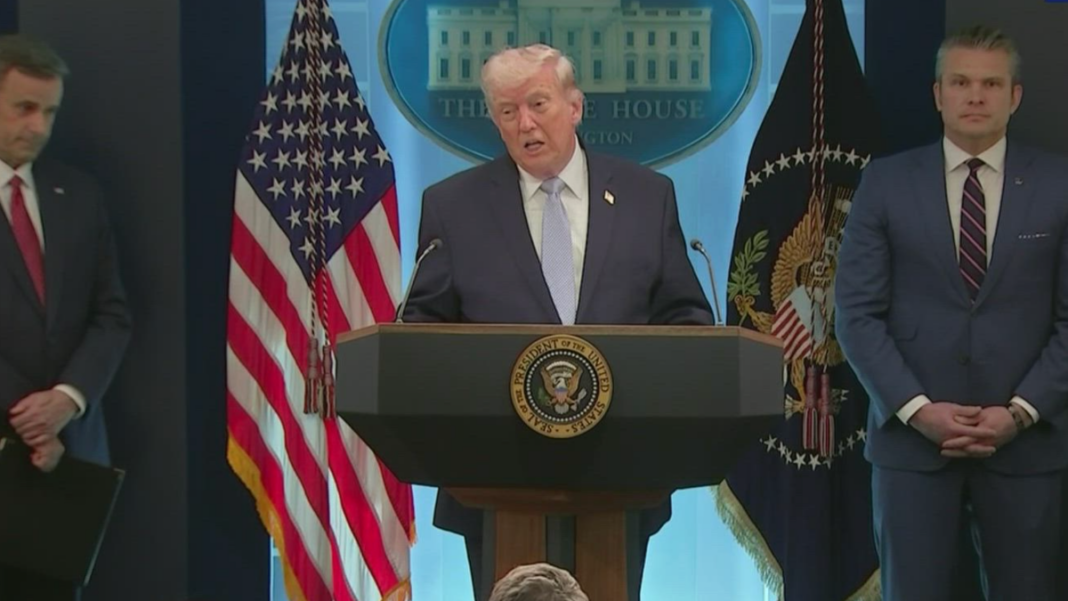
US President Donald Trump has agreed to suspend bombing Iran for two weeks after accepting a 14-day truce proposal, in a dramatic de-escalation after days of threats that had pushed the Middle East closer to a wider regional war.
Trump said the pause was conditional on Iran agreeing to the “complete, immediate, and safe” reopening of the Strait of Hormuz, while also saying Washington had received a 10-point Iranian proposal that could serve as a workable basis for negotiations.
The breakthrough was brokered with Pakistan playing a central mediating role. Reuters reported that Pakistan’s Prime Minister Shehbaz Sharif said he had invited Iranian and US delegations to meet in Islamabad on Friday.
In contrast, Iran’s Foreign Minister Abbas Araqchi said Tehran would halt counter-attacks and allow safe transit through the Strait of Hormuz in coordination with Iranian armed forces. The waterway is one of the world’s most critical energy choke points, handling about a fifth of global oil shipments.
The ceasefire announcement marked a sharp reversal from Trump’s earlier rhetoric. Just hours before the deal, he had threatened devastating attacks on Iran’s civilian infrastructure and warned that “a whole civilisation” could die if Tehran did not comply with his demands. Reuters said the sudden pivot came less than two hours before Trump’s deadline for Iran to reopen the Strait or face a much broader assault.
Even so, the truce looked fragile almost as soon as it was declared. Reuters reported it was not immediately clear how quickly the ceasefire would take full effect, with the Israeli military still reporting missiles launched from Iran after Trump’s announcement and several Gulf states issuing alerts and activating air defences. That has left uncertainty over whether the two-week pause can last long enough to become a broader political settlement.
Financial markets responded immediately. Oil prices slid back below US$100 a barrel after the announcement, with Brent crude down 13.6 per cent to US$94.43 and West Texas Intermediate down 14.3 per cent to US$96.82 in early trading, reflecting hopes that a temporary reopening of Hormuz could ease the supply shock that has rattled global fuel markets.
For Australia, the development matters well beyond diplomacy. Prime Minister Anthony Albanese and Foreign Minister Penny Wong said in a joint statement that Australia welcomed the two-week ceasefire and had been calling for de-escalation for some time.
They said Iran’s de facto closure of the Strait of Hormuz, together with attacks on vessels and energy infrastructure, had caused “unprecedented energy supply shocks” and pushed up oil and fuel prices, and they thanked Pakistan, Egypt, Türkiye and Saudi Arabia for helping advance the ceasefire effort.
Albanese also sharpened his criticism of Trump’s earlier language. In a Sky News interview published by the Prime Minister’s office, he described the threat of damage to civilian infrastructure as “an extraordinary statement” and said it was not appropriate to use language of that kind. At the same time, he said the ceasefire itself was “very positive” and expressed hope it would lead to a permanent de-escalation and eventual resolution of the conflict.
The truce also arrives as Australia continues to manage its own fuel vulnerability. Reuters reported earlier this week that Energy Minister Chris Bowen said Australia had secured fuel shipments well into May, but the government has still been scrambling to protect supply chains as the war sent diesel and petrol prices sharply higher.
If the Hormuz passage remains open and talks in Islamabad gain traction, the immediate pressure may ease. But if the ceasefire breaks down, the world could find itself back on the edge of a deeper economic and military crisis within days.
Support our Journalism
No-nonsense journalism. No paywalls. Whether you’re in Australia, the UK, Canada, the USA, or India, you can support The Australia Today by taking a paid subscription via Patreon or donating via PayPal — and help keep honest, fearless journalism alive.
