

By Dr Madhurima Nayak
I have often lectured about history in classrooms, but walking through the monuments of Lucknow with my students reminded me that some lessons are better learned outside books. What was meant to be a routine documentary assignment gradually became something deeper. As we moved through the historic quarters of Lucknow, the day turned into an encounter with the city’s layered past and a small yet meaningful effort to reclaim narrative authority – an attempt to see and represent heritage from within rather than through the inherited lenses of a colonial “gaze”.
Lucknow’s origins can be traced to the Suryavanshi dynasty. The city was originally known as Lakhanapuri, named after Lakshmana, the brother of Sri Rama, and later evolved into the name Laukhnau. The presence of Lakshman Tila in the older part of the city is often cited as a reminder of this early association.
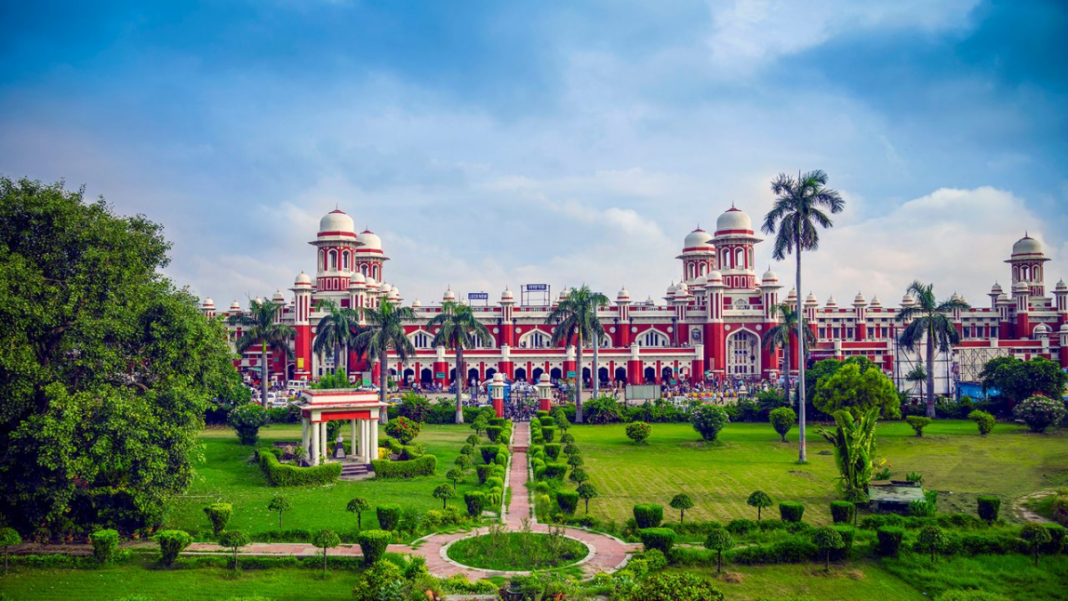
Modern Lucknow – with its expanding neighbourhoods and busy streets – stands alongside the older, tradition-bound quarters of the city. In these spaces, the past does not quietly retreat into museums; it remains embedded in gateways, towers and riverbanks that continue to anchor everyday life.
As cameras were adjusted, tripods unfolded and students debated camera angles, I stood looking at the imposing Bara Imambara. Its soaring arches and expansive courtyard remain impressive even after centuries. From Bara Imambara, the eye is drawn toward the magnificent Husainabad Clock Tower. Tall and slender, the tower stands with solemn majesty, almost as if calmly charting the passage of time in a city rich with centuries of memory.
Another striking landmark was the arch of the Rumi Darwaza. Standing beneath its ornate carvings, a local resident enthusiastically pointed out that some decorative patterns on the gateway resemble black cardamom – a spice widely used in Awadhi cuisine – while others echo the neckline designs found in the famous chikankari embroidery of Lucknow. Whether historically intended or imaginatively interpreted, such explanations reveal how monuments continue to live through the stories people attach to them.
Nearby stands the unfinished Satkhanda tower. Originally intended to rise seven storeys high, the structure remained incomplete after the sudden death of its patron, Nawab Mohammad Ali Shah. Even unfinished, it remains a striking reminder of ambitions interrupted by history.
Our final destination was the serene Kudiya Ghat along the banks of the Gomti River. In contrast to the imposing monuments earlier in the day, the ghat possessed a quiet, contemplative atmosphere. Local tradition holds that the site is named after Sage Kaundilya, who is believed to have founded an ashram nearby. Small temples line the descending steps toward the river, their bells occasionally chiming as rituals unfold in quiet devotion.
Around these sacred steps, small shops and stalls have gradually emerged to serve visitors and pilgrims, illustrating how ancient spaces adapt to contemporary realities. During my doctoral studies at Banaras Hindu University in Varanasi, I encountered the fascinating coexistence of ancient traditions and modern life that characterises many historic Indian cities. In Lucknow too, that coexistence is unmistakable. Modern shops rise beside sacred ghats. Busy traffic passes beneath centuries-old gateways. The new city expands, but the old one firmly holds its ground.
As the day drew to a close at Kudiya Ghat, the sun slowly descended into the calm waters of the Gomti River. The monuments we had visited throughout the day gathered in memory — the unfinished tower of Satkhanda, the arch of Rumi Darwaza, the solemn dignity of the Husainabad Clock Tower.
Journeys to historic cities often end where they began: with a return to the present. Yet such returns are never quite the same. One leaves with the realisation that heritage is not merely something we visit and depart from. It travels back with us – in stories, photographs and quiet reflections – reminding us that the past does not remain confined to monuments. It continues to accompany us, shaping the way we see the cities we inhabit and the histories we carry forward.
Perhaps that is the quiet power of such encounters. Monuments do not simply preserve time; they recalibrate our sense of it. What begins as a brief academic excursion gradually becomes a shift in perception. One returns with recordings, images and notes, but something less tangible comes along as well – a renewed awareness of how the past persists within the present.
In cities like Lucknow, history does not retreat politely into archives or museum walls. It endures in stone structures, circulating stories and landscapes shaped by centuries of memory, quietly reminding us that the present is never entirely free from the weight – and continuity – of what has come before.
Contributing Author: Dr Madhurima Nayak is an Assistant Professor of English at the School of Liberal Arts and Behavioural Science, Chandigarh University, Lucknow Campus. She specialises in postcolonial literature and Indian writing in English, with research interests in decolonial imagination and literary criticism.
Support our Journalism
No-nonsense journalism. No paywalls. Whether you’re in Australia, the UK, Canada, the USA, or India, you can support The Australia Today by taking a paid subscription via Patreon or donating via PayPal — and help keep honest, fearless journalism alive.
