

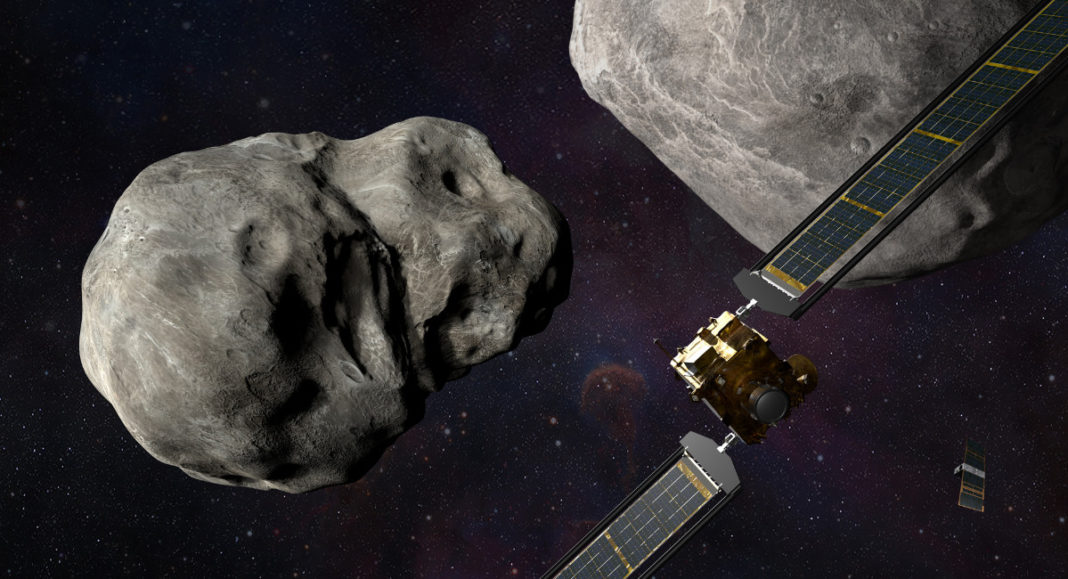
Scientists analysing data from NASA’s asteroid-deflection experiment have confirmed that the impact from the Double Asteroid Redirection Test (DART) spacecraft not only changed the orbit of an asteroid moonlet but also produced a tiny shift in the motion of the entire asteroid system around the Sun.
The DART spacecraft intentionally struck Dimorphos, a small moonlet orbiting the larger asteroid Didymos, in September 2022. While the mission’s primary objective was to test whether a spacecraft could alter the orbit of the smaller body, researchers have continued analysing observations collected by telescopes worldwide.
Compiled timelapse of DART’s final 5.5 minutes until impact (Wikipedia)
Recent studies show that the collision caused a minute slowdown in the binary asteroid system’s journey around the Sun. Scientists estimate that the system’s solar orbit was shortened by about 0.15 seconds per orbit. Given that Didymos and Dimorphos take roughly 769 days to complete one orbit around the Sun, the change represents a velocity difference of only around 10 micrometres per second.
Although extremely small, the effect is measurable with modern astronomical observations. Researchers calculate that the impact slightly reduced the overall size of the asteroid system’s solar orbit by approximately 720 metres along its path of roughly 480 million kilometres.
The latest findings build on the original result announced shortly after the DART collision. In the months following the impact, astronomers confirmed that Dimorphos’ orbit around Didymos had changed significantly.
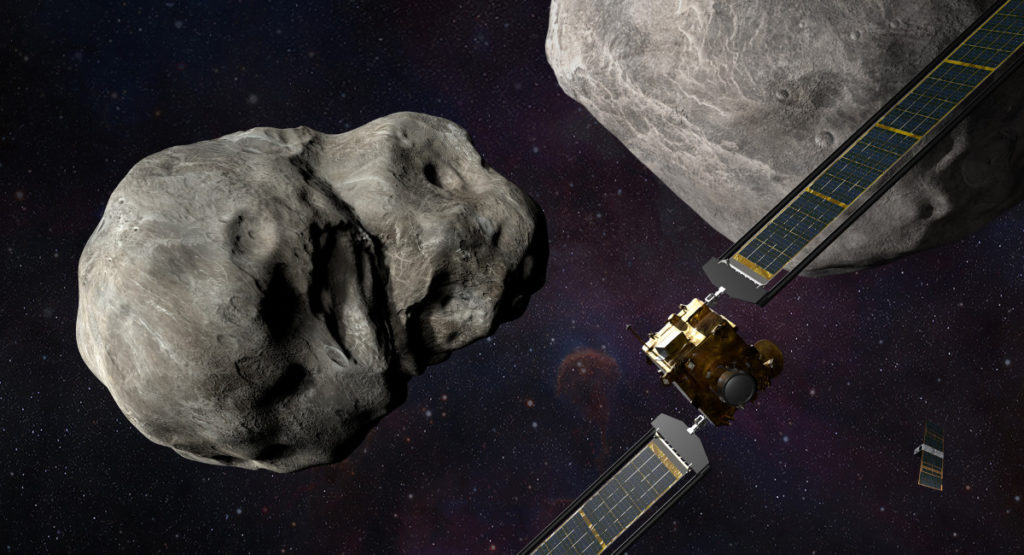
Credits: NASA/Johns Hopkins APL/Steve Gribben
Before the collision, Dimorphos completed one orbit around the larger asteroid in about 11 hours and 55 minutes. After the impact, the orbital period was shortened by approximately 33 minutes. The mission had aimed to produce a change of at least 73 seconds, meaning the observed shift far exceeded the minimum success threshold.
The DART mission was designed as the first real-world test of the kinetic impactor method — striking an asteroid with a spacecraft to alter its motion. The target system was chosen specifically because Dimorphos posed no threat to Earth, allowing scientists to safely measure the effects of a deliberate collision in space.
Observations after the impact also revealed a large plume of rock and dust ejected from the asteroid’s surface. This debris contributed additional momentum, amplifying the deflection caused by the spacecraft itself.
Further investigation of the asteroid pair will be carried out by the European Space Agency’s Hera spacecraft, which is expected to arrive at the Didymos–Dimorphos system later this year. Hera will map the impact site, measure the mass and structure of the asteroids, and provide more precise data on how the collision changed their motion.
Together, the results from DART represent the first practical demonstration that humans can deliberately alter the movement of a celestial object — an important step in developing technologies that could one day help protect Earth from hazardous asteroids.
Support our Journalism
No-nonsense journalism. No paywalls. Whether you’re in Australia, the UK, Canada, the USA, or India, you can support The Australia Today by taking a paid subscription via Patreon or donating via PayPal — and help keep honest, fearless journalism alive.
