

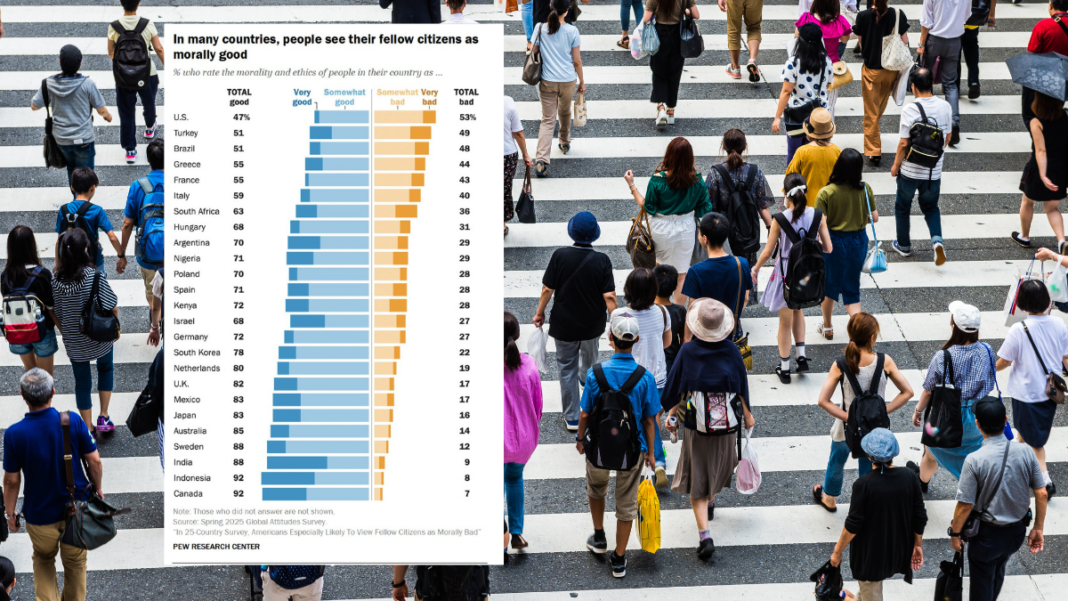
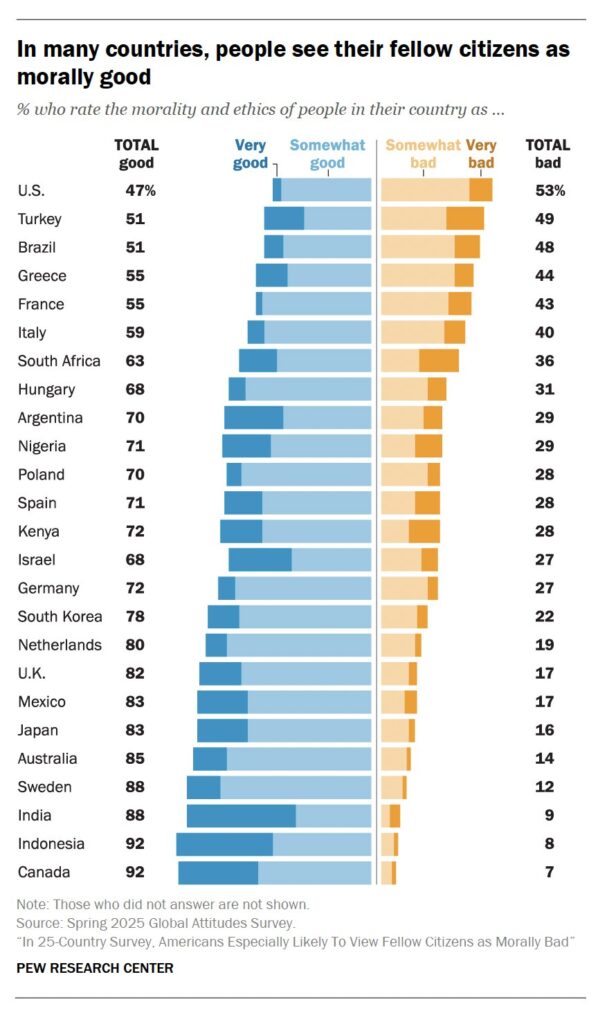
Americans are more likely than people in most other countries to judge their fellow citizens as morally deficient, according to a new global survey, highlighting stark differences in self-perception across the world. In contrast, residents of Australia, India, and Canada generally view their fellow citizens’ ethics more positively, even as attitudes toward specific behaviours vary.
The Pew Research Center survey, conducted between January and May 2025 across 25 countries and involving more than 30,000 adults, asked respondents to evaluate the morality and ethics of others in their country.
The results were striking: 53 per cent of U.S. adults described other Americans as “bad” in morals and ethics, making the U.S. the only country where a majority judged fellow citizens negatively. By comparison, majorities in India, Canada, and Australia described their compatriots as morally good.
Partisan politics appear to shape these perceptions in the United States. Democrats and independents who lean Democratic were far more likely than Republicans to rate other Americans as morally bad — 60 per cent compared with 46 per cent.
Researchers note that similar patterns exist elsewhere: in over half of the countries surveyed, citizens who do not support the governing party tend to view fellow citizens as immoral.
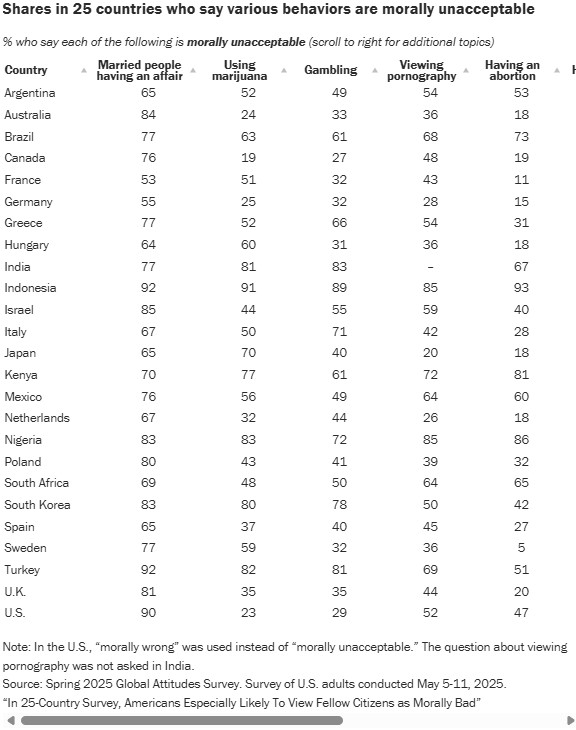
Beyond general perceptions, the survey explored nine specific behaviours, including extramarital affairs, abortion, homosexuality, alcohol consumption, gambling, and marijuana use.
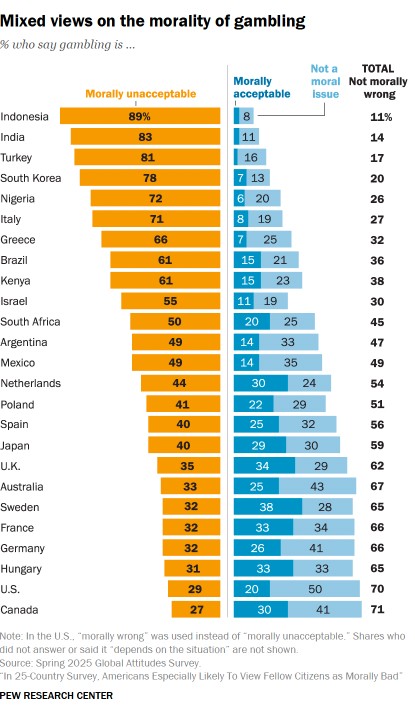
Americans were among the most stringent in condemning extramarital affairs, with nine in ten adults labelling them morally wrong, aligning with disapproval in countries such as Indonesia and Turkey. At the same time, U.S. adults were relatively permissive about gambling and marijuana, with just 29 per cent and 23 per cent respectively calling these practices morally unacceptable.
Australians and Canadians showed broadly similar trends on these behaviours. Around two-thirds of adults in both countries said gambling was morally acceptable or not a moral issue, while attitudes toward marijuana use were also more tolerant than in many other countries surveyed.
Canadians, like Australians, generally fell in the middle range on other behaviours such as abortion and homosexuality.
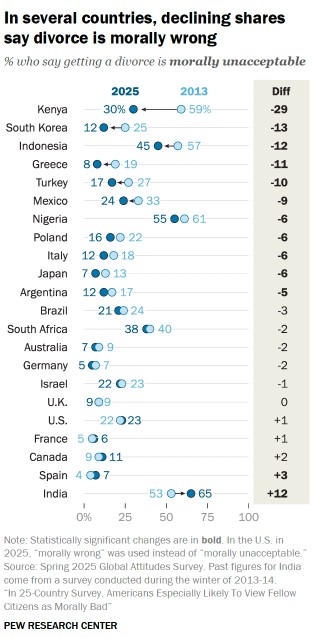
India presented a more conservative profile on some issues. Sixty-five per cent of Indian adults said divorce is morally wrong, up from 53 per cent in 2013, while a majority also viewed abortion as morally unacceptable.
Religious affiliation strongly influenced opinions: in India, women were slightly more likely than men to judge divorce and abortion as wrong, echoing patterns observed globally, though men were often stricter on issues such as homosexuality.
Gender, age, and education shaped moral attitudes across all four countries. Women tended to be more critical than men of gambling, alcohol, and pornography, while men were more likely to condemn homosexuality.
Older adults expressed stronger moral disapproval of behaviours such as marijuana and alcohol use, whereas younger Americans were slightly more likely than older Americans to rate fellow citizens as morally bad. Individuals with lower levels of education were also more likely to label certain behaviours as morally unacceptable.
The survey further highlights changes over time. Comparing the 2025 results with Pew data from 2013, disapproval of divorce, homosexuality, and abortion has generally declined worldwide, though India remains an outlier with increased disapproval of divorce. Meanwhile, countries such as Kenya, Indonesia, and Mexico have seen significant drops in moral condemnation of divorce over the decade.
The study offers a rare comparative lens on how morality is perceived across cultures and demographics, revealing that Americans’ critical view of themselves stands out internationally. Meanwhile, residents of India, Canada, and Australia generally maintain a more forgiving perspective toward their fellow citizens, even as opinions diverge sharply on specific social behaviours.
Support our Journalism
No-nonsense journalism. No paywalls. Whether you’re in Australia, the UK, Canada, the USA, or India, you can support The Australia Today by taking a paid subscription via Patreon or donating via PayPal — and help keep honest, fearless journalism alive.
