


By Stephen Howes and Huiyuan (Sharon) Liu
PALM (Pacific Australia Labour Mobility) growth has stalled. The total number of PALM workers in Australia was 26,185 in April 2022, 34,230 in June 2024 and 32,365 in November 2025. But there is still plenty of churn among the ten PALM-sending countries (nine Pacific Island countries plus Timor-Leste) from which employers are sourcing their workers.
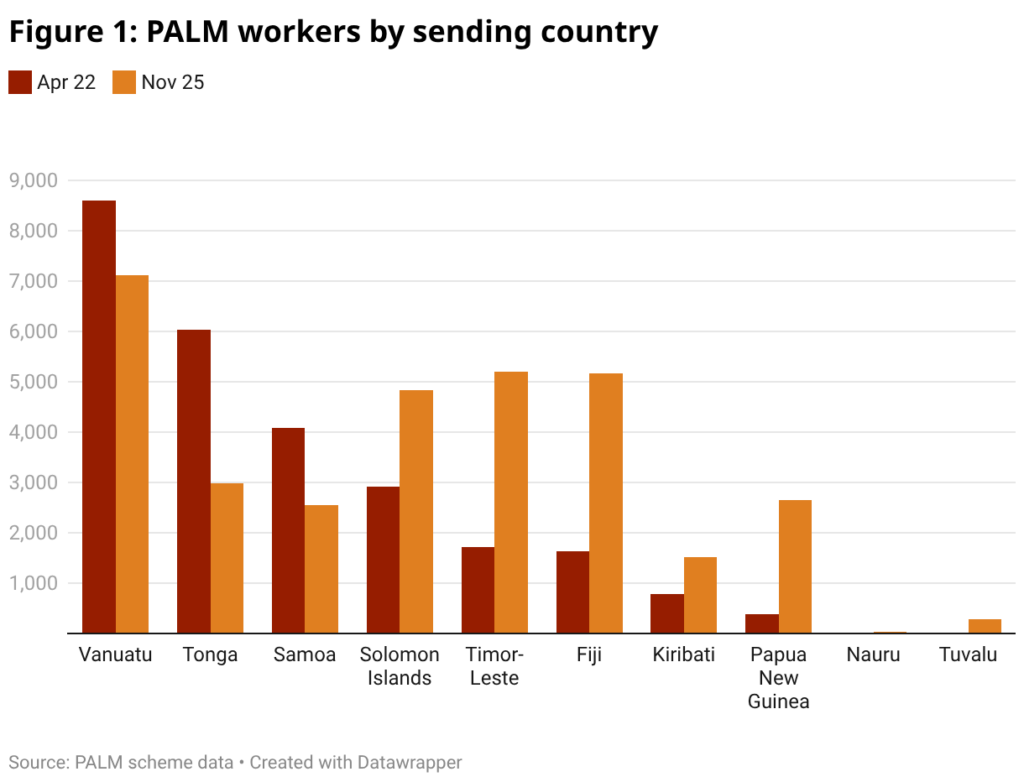
The overall trend is one of diversification. In April 2022, a single country, Vanuatu, supplied one-third of all PALM workers. Vanuatu has since lost and then regained its top slot. However, it now provides only 22% of all PALM workers. In April 2022, Tonga was the second-biggest sender of workers. Tonga’s PALM numbers have since halved and as of November Timor-Leste was in second place. The top two now only provide 38% of PALM workers, down from 56% in early 2022 (and 70% or more before the pandemic).
It is also instructive to look at changes in the absolute numbers working in Australia under the PALM scheme by sending country. The top three providers in April 2022 — Vanuatu, Tonga and Samoa — are today between them providing only two-thirds of the number of PALM workers they did back then. The resulting gap has been filled by the other seven participating countries, all of whose numbers have increased. Fiji, Solomon Islands and Timor-Leste each have about 5,000 PALM workers in Australia, more than either Tonga or Samoa currently.
Another big change is in the shares of long-term (LT) and short-term (ST) workers. The latter come for less than a year and mainly work on farms. The former come for up to four years and work mainly in abattoirs. The share of long-term workers in total PALM workers has increased from 27% in April 2022 to 53% in June 2024 and has been roughly unchanged since.
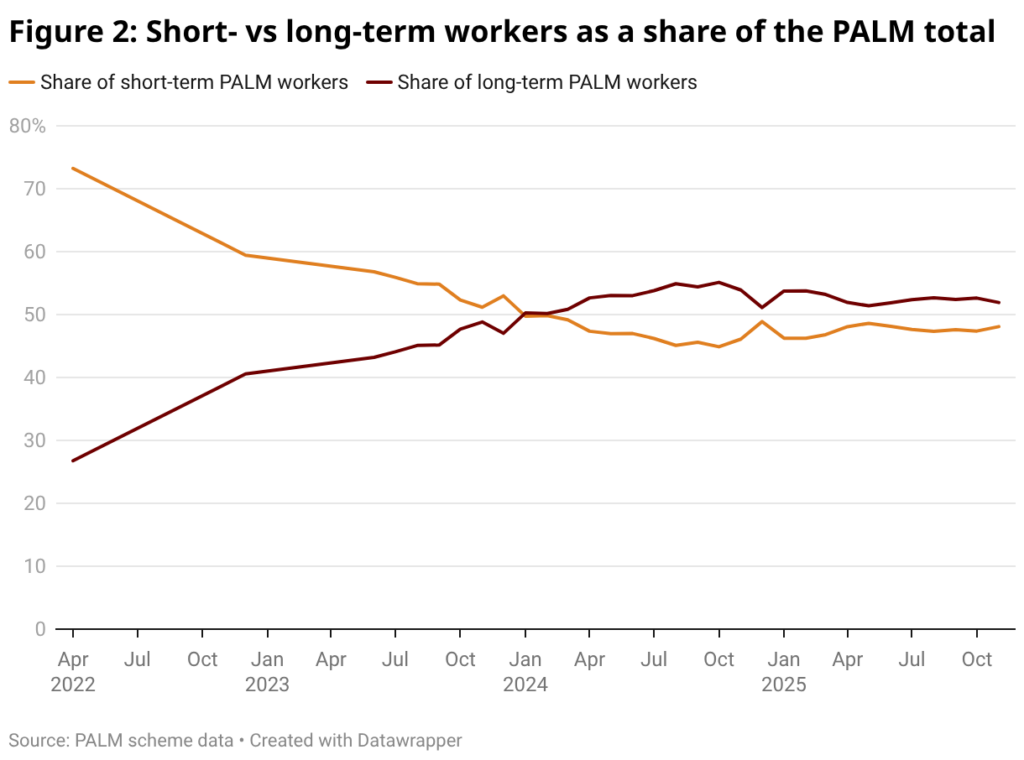
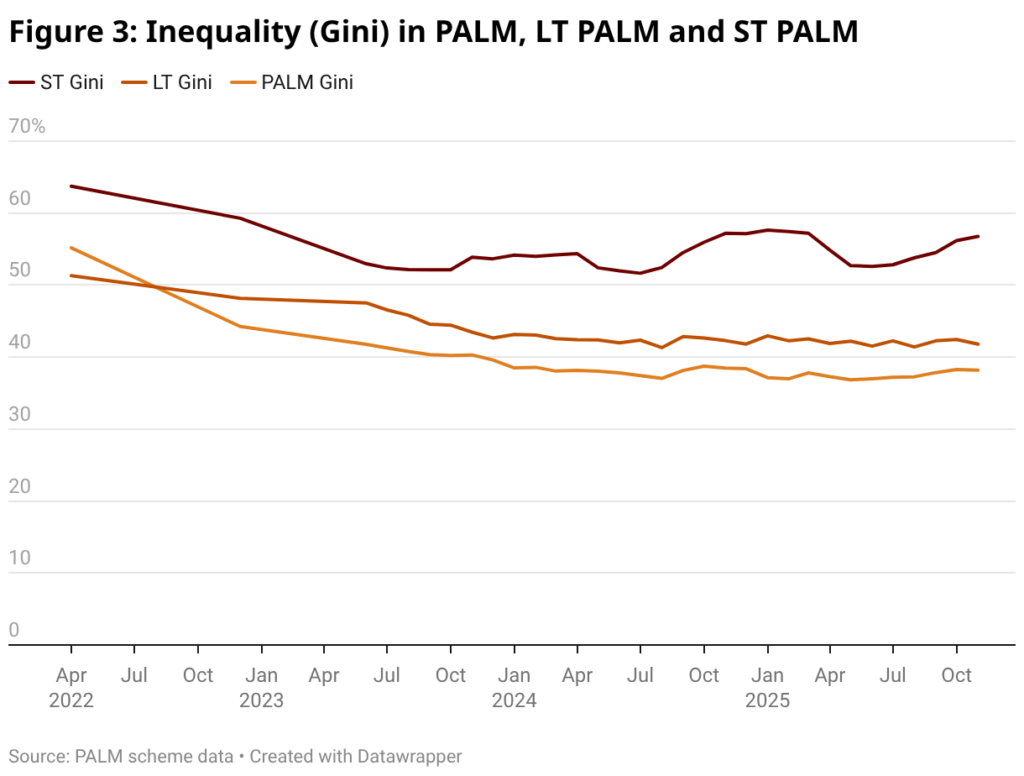
It turns out these two changes are linked. There is less inequality in the distribution of workers across sending countries in the LT component of the PALM scheme. As it has grown more important, this has pushed down the overall inequality.
The figure below illustrates. The Gini is the best known measure of inequality. The graph shows the Gini for PALM inequality between countries both as a whole and in both the ST and LT PALM streams. The fall in the total Gini (31 percentage points, start to end) is larger than the fall in either the ST Gini (11 percentage points) or the LT Gini (19 percentage points). That’s because of that increase in the share of the lower-inequality LT PALM (Figure 2).
While exact shares can vary from month to month, the overall trends are clear. This equalisation across countries in their contribution of workers is a very positive development. The three countries where complaints about brain drain and labour shortages have been the loudest are the ones in which PALM numbers have fallen: the former big three of Vanuatu, Tonga and Samoa. And the countries that have wanted to grow their PALM numbers have been able to, though PNG is still lagging.
An important message from this analysis, though, is that diversification seems to have run its course. The inequality in PALM across countries stopped falling almost two years ago. And the ST and LT shares have also stabilised.
If diversification has run its course, then to satisfy demand from the sending countries that still want to grow their numbers (Solomon Islands, Timor-Leste and PNG, and perhaps Kiribati, Fiji and Tonga as well), the Australian government will need to ensure a resumption of overall PALM growth. How could it do this?
Renewed PALM growth is possible, but only with reform. Employers would like the scheme to be less tightly regulated, but this is unlikely. An easier win would be to encourage sectors not currently participating in the long-term PALM to do so.
Another option worth considering would be to remove the current postcode restrictions, which are currently applied selectively. A Melbourne abattoir can employ PALM workers, but a Melbourne aged-care home can’t. Removing the remaining postcode restrictions would increase PALM employment in aged care (which would also be good for gender balance), and might make PALM an attractive option for large hotels in cities.
Another reform to support a resumption of PALM aggregate growth would be to finally remove the incentives for backpackers to work on farms. The government undertook a review of the backpacker visa in its last term of government. It released a discussion paper in June 2024 on the subject and issued a call for submissions (see Howes’s here). But, as far as we of know, this review has never been concluded. It certainly hasn’t been published.
The overall message is that over the last few years countries that have wanted to grow their PALM numbers have been able to do so in part because of contraction in Vanuatu, Samoa and Tonga. The decomposition analysis suggests that might not be possible any more. If so, either some Pacific countries will be frustrated in their PALM growth aspirations or PALM reforms to enable a resumption of growth will be needed.
This article appeared first on Devpolicy Blog (devpolicy.org), from the Development Policy Centre at The Australian National University.
Disclosure: This research was supported by the Pacific Research Program, with funding from the Department of Foreign Affairs and Trade. The views are those of the authors only.
Contributing Author(s): Stephen Howes is Director of the Development Policy Centre and Professor of Economics at the Crawford School of Public Policy at The Australian National University. Huiyuan (Sharon) Liu is a research officer at the Development Policy Centre, working in the area of labour mobility.
Support our Journalism
No-nonsense journalism. No paywalls. Whether you’re in Australia, the UK, Canada, the USA, or India, you can support The Australia Today by taking a paid subscription via Patreon or donating via PayPal — and help keep honest, fearless journalism alive.
