

Amarjeet Verma
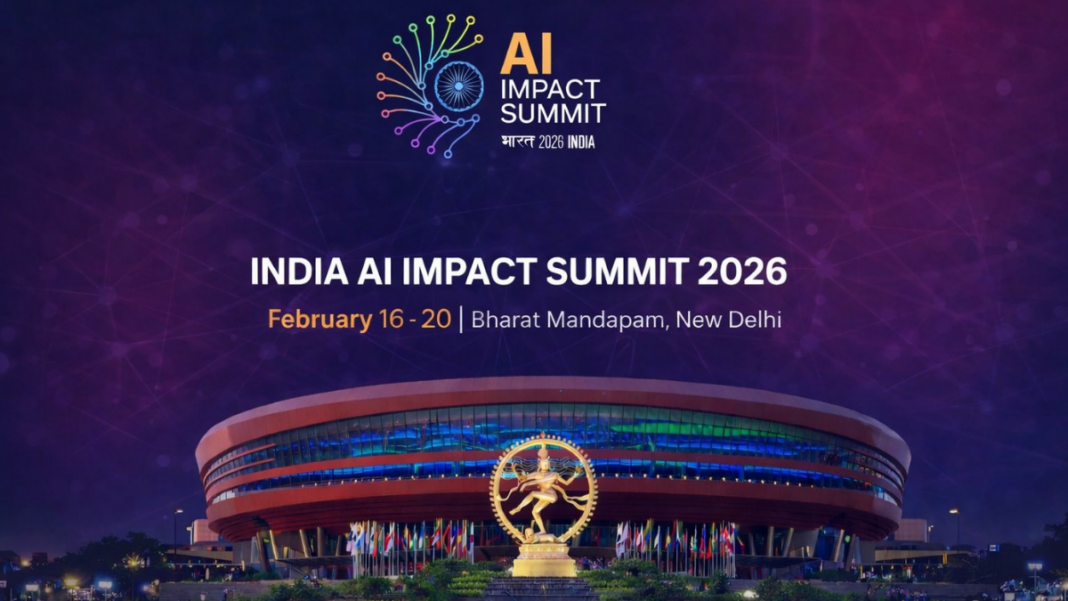
India is hosting the AI Impact Summit 2026 with participation from over 100 countries, Heads of State, CEOs and global institutions, ia geopolitical statement as much as a technological one. This summit brings together the world’s top political and technology leaders, making it one of the largest and most influential gatherings in AI to date.
Its theme, “Welfare for All, Happiness for All,” rightly signals a civilisational approach to AI: technology as a mean for greater public good, not merely a private profit engine.
The global artificial intelligence race is moving from the one who builds the most powerful models to the one who deploys them at scale, who makes them useful for humanity at large, and who shapes their moral and developmental direction. Across all three dimensions, India is stepping up as more than a participant, emerging as a global AI hub where population-scale adoption, digital infrastructure, and development goals come together.
🌍 Among the World Leaders Attending
- Emmanuel Macron — President of France
- Luiz Inácio Lula da Silva — President of Brazil
- Sheikh Khaled bin Mohamed bin Zayed Al Nahyan — Crown Prince of Abu Dhabi, UAE
- Anura Kumara Dissanayake — President of Sri Lanka
- Pedro Sánchez — Prime Minister of Spain
💼 Global CEOs Attending the Summit
- Sundar Pichai — CEO, Alphabet & Google
- Sam Altman — CEO, OpenAI
- Demis Hassabis — CEO, DeepMind
- Dario Amodei — CEO, Anthropic
- Bill Gates — Chair, Bill & Melinda Gates Foundation
- Brad Smith — President & Vice Chair, Microsoft
The numbers speak for itself. India has become the single largest active user base globally for major AI applications. ChatGPT alone has more than 145 million monthly users in India, Gemini about 105 million, and Perplexity nearly 20 million. On a daily basis, tens of millions of Indians are interacting with generative AI tools, far more than in any other country. In several platforms, India contributes between 16% and nearly 40% of global users, making it the gravitational centre of real-world AI deployment.
This statistical representation is the outcome of three structural forces; the world’s largest connected population, the lowest data costs and a robust digital public infrastructure that has already transformed finance, identity and service delivery in India. When AI meets this scale, it is destined to be a mass technology.
Simultaneously, global capital & industry are smartly moving towards this transition. Big Tech giants are committing billions in AI infrastructure. Global financial institutions are already automating core functions using AI. And long-horizon investors are openly making statements that the next two decades will belong to India’s growth story. Yet India’s AI moment is simply more than just about market size or investment flows. Its real significance lies in the message and the value it carries especially for the Global South. India is positioning itself as the bridge between technology and welfare for all.
India’s proposition is clear, AI must solve for healthcare, agriculture, education, climate resilience, language inclusion and financial access- the core challenges of the developing world. If the West’s AI race is about model supremacy, India’s is about societal deployment.
The principal question is whether India can move from being the largest user base to becoming a foundational builder. The model already exists. The digital public infrastructure- Aadhaar, UPI and the data empowerment architecture- showed how state-backed, professionally managed, open-source platforms can transform an economy.
An India AI Stack built on curated public datasets- from agriculture and geology to healthcare and multilingual voice- can do for intelligence what UPI did for payments.
India’s linguistic diversity has its own significance. A country that thinks, speaks and transacts in hundreds of languages is uniquely positioned to lead in voice-based and vernacular AI, the very mode to define inclusion in the Global South.
If AI must work for a wide range of ecosystem, like that of a farmer, a small entrepreneur, a community health worker, and a student in a non-English sphere, it will likely be designed and tested in India.
India’s workforce is already among the largest adopters and implementers of AI, especially through its global IT and consulting ecosystem. Just as Indian engineers once drove the global spread of ERP and business intelligence systems, they are now becoming the operational backbone of AI deployment worldwide. However, leadership will depend on a few critical shifts, like the deep research capacity, the ability to fund large-scale model development and infrastructure and the public-good financing models.
In this sense, the AI stack must be treated as national infrastructure – funded, governed and scaled as a shared resource.
What makes India the world’s most important AI arena is way more than just the demand; it is the combination of scale, cost-sensitive innovation and a welfare policy imagination. In developed economies, AI will optimise systems. In India and the Global South, AI will build systems where none existed. This distinction is historic in its way.
A clinical AI that works in a resource-conscious district hospital, an agricultural model that advises a small farmer in his own language, a compliance mechanism that reduces the burden on small enterprise, these are the real developmental leaps.
India’s AI expedition is a high-stakes experiment. India has the users, the data potential, the digital rails and the geopolitical moment. What it really needs is execution at research depth and institutional design at scale. If it succeeds, the global AI conversation will surely shift, from control to access, from monopoly to platforms, from efficiency to equity.
And for the first time in modern technological history, the Global South will not just be a passive consumer of a revolution. It will be the place where that revolution is made meaningful. India will be much more than just the largest AI market; it will be the arena where AI learns to serve humanity.
Contributing Author: Amarjeet Verma is a policy researcher, columnist, and aspiring author. He addresses contemporary issues spanning international relations, public policy, and politics.
Disclaimer: The opinions expressed within this article are the author’s personal opinions. The Australia Today is not responsible for the accuracy, completeness, suitability, or validity of any information in this article. The information, facts, or opinions appearing in the article do not reflect the views of The Australia Today, and The Australia Today News does not assume any responsibility or liability for the same.
Support our Journalism
No-nonsense journalism. No paywalls. Whether you’re in Australia, the UK, Canada, the USA, or India, you can support The Australia Today by taking a paid subscription via Patreon or donating via PayPal — and help keep honest, fearless journalism alive.
