


Angus Taylor has been elected leader of the federal Liberal Party after defeating Sussan Ley in a decisive party room ballot, marking a major shift in Australia’s opposition leadership and triggering immediate political fallout in Canberra.
The leadership spill was confirmed after Liberal MPs voted to vacate Sussan Ley’s position, with Taylor subsequently winning the leadership contest by a clear margin of 34 votes to 17, according to party whip Aaron Violi. The result was stronger than many political observers had anticipated and signals significant backing for Taylor within the Liberal caucus.
Victorian senator Jane Hume was elected deputy leader following a separate ballot, defeating Queensland MP Ted O’Brien in the final round by 30 votes to 20. The deputy leadership contest involved multiple candidates, with Dan Tehan and Melissa Price eliminated in earlier rounds.
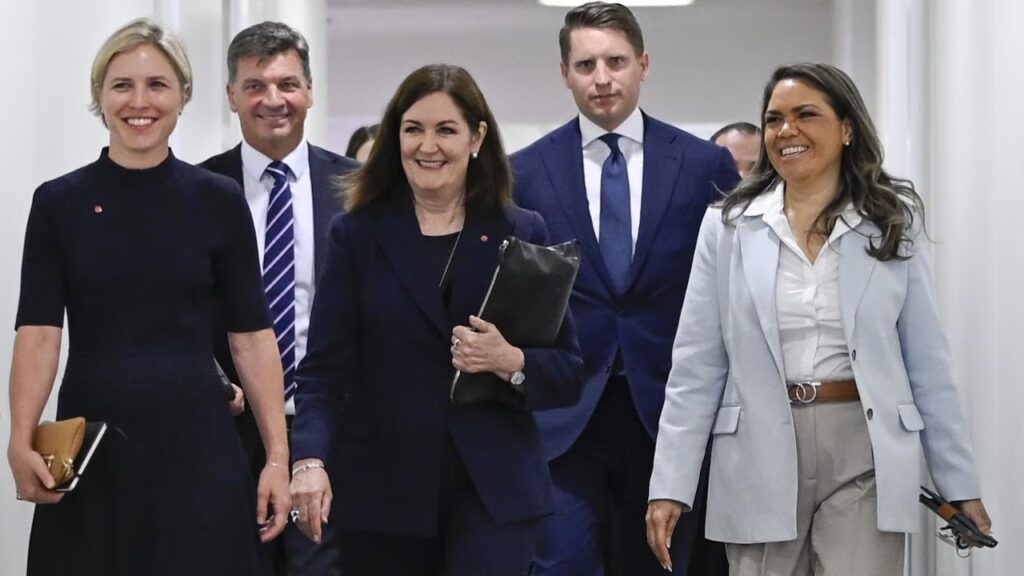
The leadership change comes amid ongoing instability within the Liberal Party following its landslide defeat at the 2025 federal election, which saw Labor secure a commanding parliamentary majority and weaken the Coalition’s position nationally.
Spill motion ends Ley’s leadership
The leadership contest was triggered after Liberal MPs voted in favour of a spill motion, effectively ending Ley’s tenure as leader. The motion itself passed with a similar margin, demonstrating strong internal momentum for change.
Ley, who had taken over leadership following the Coalition’s election loss, left the party room with supporters following the vote and was later applauded by colleagues in her office. She did not immediately address the media.
Taylor and Ley were the only candidates to formally nominate for the leadership, reflecting a direct contest between two senior figures within the party.
Deputy leadership reshaped
Jane Hume’s election as deputy leader strengthens the party’s economic and policy leadership team. Hume, a Victorian senator and former finance spokesperson, defeated Ted O’Brien after a competitive multi-round vote.
Dan Tehan received 11 votes in the second round before being eliminated, while Melissa Price was eliminated in the first round after securing just two votes.
Hume’s victory positions her as a key figure in rebuilding the party’s economic messaging and reconnecting with voters after recent electoral setbacks.
Immediate political reaction
The leadership outcome drew swift political reactions from across the spectrum. Prime Minister Anthony Albanese and Labor strategists quickly launched campaign messaging targeting Taylor, seeking to tie him to previous Coalition economic policies and leadership decisions.
Labor released online advertisements shortly after the result was announced, portraying Taylor as part of the previous Coalition leadership team and framing him as a continuation of the past political direction.
Meanwhile, former Liberal prime minister Tony Abbott publicly endorsed Taylor’s leadership, calling on party members to unite behind him and focus on rebuilding voter support.
Party unity and future direction
Taylor’s election comes at a critical moment for the Liberal Party as it attempts to recover from electoral losses, internal divisions and declining support in key metropolitan areas.
The leadership change is expected to influence the party’s policy direction, electoral strategy and positioning ahead of the next federal election, which is due by 2028.
Taylor, who previously served as shadow treasurer, is regarded as a senior economic voice within the party and is expected to focus heavily on economic management, cost-of-living pressures and fiscal policy as central themes of the opposition’s platform.
The leadership reshuffle also reflects broader efforts by the Liberal Party to reset its public image, rebuild internal unity and re-establish itself as a competitive alternative government.
Leadership transition marks a turning point
The decisive nature of the vote underscores a clear majority within the party seeking a change in leadership and direction. With Taylor and Hume now leading the Liberal Party, attention will turn to how the opposition reshapes its strategy and messaging in response to Labor’s dominance and evolving political dynamics.
The coming months are likely to determine whether the new leadership team can stabilise the party, unify factions and rebuild voter confidence ahead of the next national poll.
Support our Journalism
No-nonsense journalism. No paywalls. Whether you’re in Australia, the UK, Canada, the USA, or India, you can support The Australia Today by taking a paid subscription via Patreon or donating via PayPal — and help keep honest, fearless journalism alive.
