

S. M. Faiyaz Hossain
Bangladesh heads to the polls on February 12, 2026, in what could be a make-or-break moment for its fragile democracy. This is 18 months after violent student-led fury toppled the Awami League Government on August 5, 2024. Sheikh Hasina, Bangladesh’s longest-serving female prime minister and daughter of Bangladesh’s founder Sheikh Mujibur Rahman, flew in exile to India on a Military Helicopter.
The Awami League was officially banned in Bangladesh in May 2025, when the interim government barred all party activities under the Anti‑Terrorism Act amid ongoing tribunal proceedings against its leaders — a move widely viewed as politically motivated.
Awami League’s lowest seat tally in their history was 62 out of 300 seats in the 2001 Bangladesh polls, despite securing 40.13% votes. After the July uprising, the party defied predictions of its demise by winning local bar council elections, though its formal ban later restricted Awami League-backed candidates from participating. According to Voice of America’s Independent survey, 57% Bangladeshis supported Awami League’s return to politics, contradicting the executive decision to ban the party.

With the Awami League’s secular bloc absent, Bangladesh’s centre-right BNP and the Islamist oriented Jamaat E Islami now confront each other, reshaping the nation’s first completely religiously inclined election.
Interim Govt’s campaign for a Yes vote in constituent assembly referendum sparked conflict of interest claims and interference in the voting system. A writ petition challenged the legal basis of the assembly implementing the July Charter and conducting the election by the Interim Govt.
Australia pledged AU$2 million to support Bangladesh in holding a transparent, inclusive, and peaceful national election known as the Ballot Project. Following the formation of the military-backed interim government Australia also opened a new Home Affairs office in Dhaka.
Despite the violent July uprising, Australia surprisingly spiked student intakes and upgraded the student visa category to level 1. However, in January 2026, Australia downgraded Bangladesh to high-risk Level 3 due to severe integrity allegations.
Australia kept supporting the interim government’s alleged reform initiatives and maintained continued diplomatic correspondence regarding Indo-Pacific and National Security. Australia’s DFAT Country information report on Bangladesh though during the interim period highlights many human Rights concerns, including that Awami League activists are unlikely to receive justice.
Australia’s Ties since the Independence of Bangladesh
The Australian public played a real part in Bangladesh’s 1971 Liberation War. Canberra quickly recognised Sheikh Mujibur Rahman’s Awami League government on January 31, 1972. Before that, Prime Minister William McMahon pushed Pakistan to find a political solution. Australians rallied, collecting aid for Bengali refugees pouring out of the conflict.
Mr William Ouderland from Perth, once a guerrilla commando, trained Bengali freedom fighters to fight against Pakistan. He earned the Bir Pratik gallantry award from the Awami League government in 1972.
The official suppression of the Awami League
Human Rights Watch blasted Muhammad Yunus’s interim government for using harsh Anti-Terrorism Act amendments to crack down on Awami League supporters, calling it draconian. On May 12, 2025, the government slapped a “temporary” nationwide ban on all Awami League activities. Meetings, publications, and even social media posts are all off-limits while courts investigate alleged abuses from Sheikh Hasina’s long rule. Six Human Rights Organisations wrote a joint letter to the interim Govt to remove the ban.
The protest to ban the Awami League quickly spiralled, turning into a scene charged with extremist energy. Islamist groups, some previously convicted of having ties with Al Qaida, participated in the crowd. At the centre, Mufti Jashimuddin Rahmani, a cleric infamous for his radical views, waved the flag of Taliban.
Members of the banned Hizb ut-Tahrir, Hefazat-e-Islam, and Rahmani’s associates with criminal records showed up, their presence thickening the tension in the streets. The demonstration splintered; Jamaat E Islami and Islami Chatra Shibir broke off, shouting, “No Awami League in the land of Nizami, no Awami League in the land of Golam Azam.”
Abdullah Al Noman Shamim, Secretary General of the Awami Youth League in Australia and a member of the Australian Labour Party, said:
“Canberra was regularly briefed about human rights abuses and undemocratic crackdowns under Muhammad Yunus’s interim regime. Things like the Anti-Terrorism Act, which suspended Awami League activities defying UN Recommendations, didn’t go unnoticed. At first, Australian officials seemed dazzled by Yunus’s global reputation, but now, with the February 12 non-inclusive polls coming up, they can notice the reality.”
Still, Noman points out in concern, “no one’s really being held responsible. Bangladeshi Australians pushed hard. They reached out to the Australian Government, human rights organisations, and the mainstream media, urging them to pay attention and look beyond the reforms.”
The Election Australians are funding
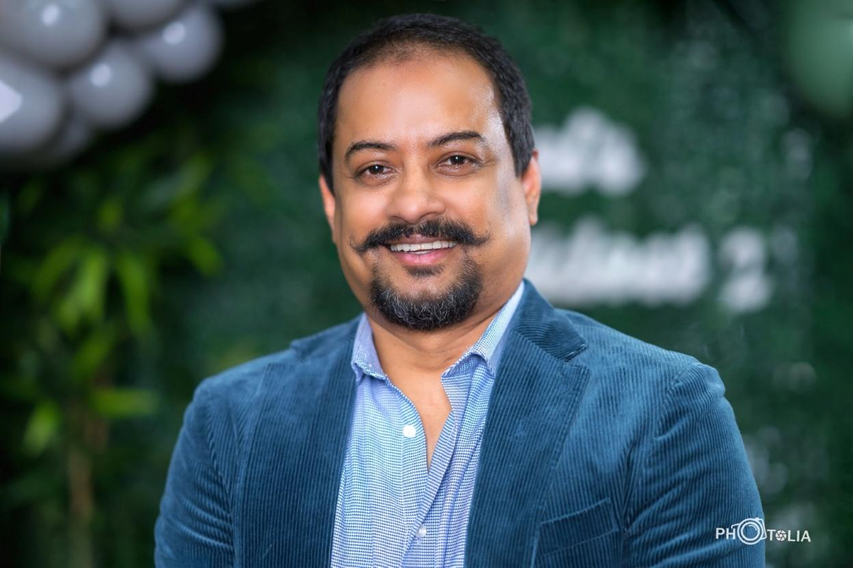
‘‘True democracy requires the participation of all political parties,’’ said Dr AKM Jamal Uddin, Professor of Sociology at the University of Dhaka.
He criticized Yunus’s government for banning major parties, including the Awami League, calling the upcoming election one-sided and undemocratic. He also doubts the number of voters could be fraudulently inflated to make the election appear legitimate, warning it poses a threat to regional and global stability.
‘‘In my view, the security forces did kill protesters, while some demonstrators and Islamist infiltrators also resorted to violence. However, I personally did not see any Awami League activists in civilian clothes shooting at protesters.’’ said a July protester and former leader of a newly formed student party, NCP, Ms Neela Israfil.

‘‘Such funding of the ballot project by countries like Australia and the EU creates a dangerous precedent. Western nations usually oppose party bans, so supporting such an election by a democratic country is truly tragic,’’ added Dr Imran H. Sarker, exiled leader of the Gana Jagaran Mancha.
“Just as Australia downgraded Bangladeshi student visa intake from Level 1 to Level 3 due to visa and documentation fraud, they must act on this non-inclusive fraud election already funded by hard-earned taxpayer money,’’ said an Australian Bangladeshi who did not wished to be named.
The Canadian Human Rights Network, Global Centre for Democratic Governance, counted 47 extrajudicial killings during the Interim Government’s short transition until June 2025. Meanwhile, Paris-based JMBF logged 60 separate incidents, with 70 people killed without due process, between July 2024 and August 2025. A Report by Odhikar, a Dhaka-based Human Rights group, stated that at least 281 people have been killed due to Political Violence since the Interim Govt took over until September 2025.
The interim government also targeted 640 journalists, using legal tools to silence them. Journalist Ashequn Nabi Chowdhury describes the interim rule in a CPJ Article as the most Perilous moment for Bangladeshi Journalism. Transparency International Bangladesh linked Sheikh Hasina to 663 graft cases, and both HRW and Amnesty International criticised her death penalty as an unfair trial.
A group of US Lawmakers wrote a letter to Chief Adviser Muhammad Yunus, expressing concern about the total ban of the Awami League ahead of the election.
“Bangladeshi people deserve the opportunity to choose an elected government through a free and fair election,” said the U.S. lawmakers
British MP Bob Blackman did not hold back in the Parliament when he addressed Bangladesh’s political climate and human rights issues, especially with national elections on the horizon. He called out the ongoing ban on Bangladesh’s Awami League, warning that keeping a major party out of the process raises serious doubts about the country’s commitment to democracy.
“If political parties are prevented from standing in elections, democracy itself is placed in question,” said Blackman.
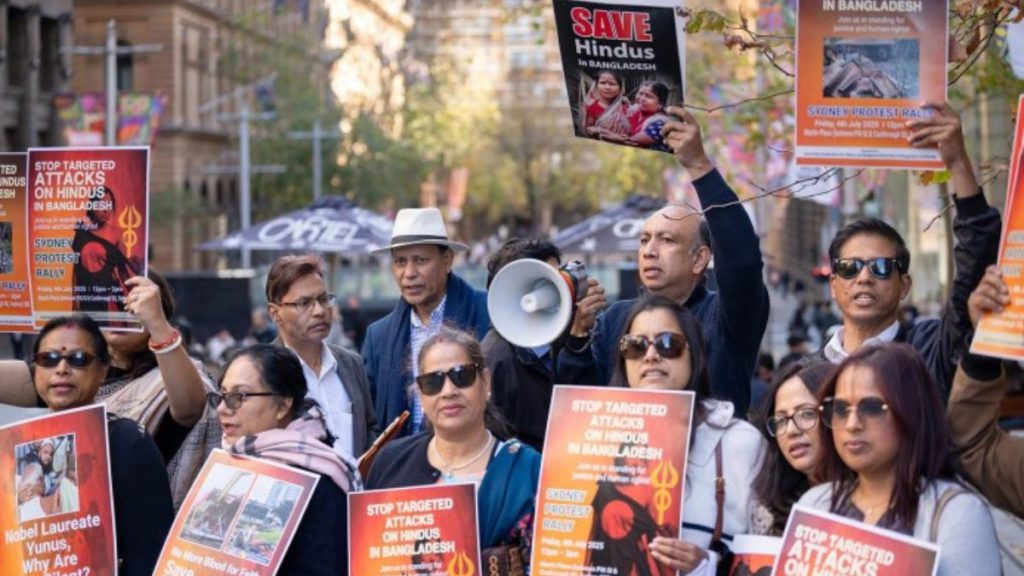
Blackman also spoke out strongly against violence targeting Bangladesh’s Hindu minority, citing killings and the destruction of temples, which he described as grave assaults on human rights and religious freedom.
Contributing Author: S M Faiyaz Hossain is a Bengali Freelance Journalist and contributor, based in Australia
Disclaimer: The opinions expressed within this article are the author’s personal opinions. The Australia Today is not responsible for the accuracy, completeness, suitability, or validity of any information in this article. The information, facts, or opinions appearing in the article do not reflect the views of The Australia Today, and The Australia Today News does not assume any responsibility or liability for the same.
Support our Journalism
No-nonsense journalism. No paywalls. Whether you’re in Australia, the UK, Canada, the USA, or India, you can support The Australia Today by taking a paid subscription via Patreon or donating via PayPal — and help keep honest, fearless journalism alive.
