

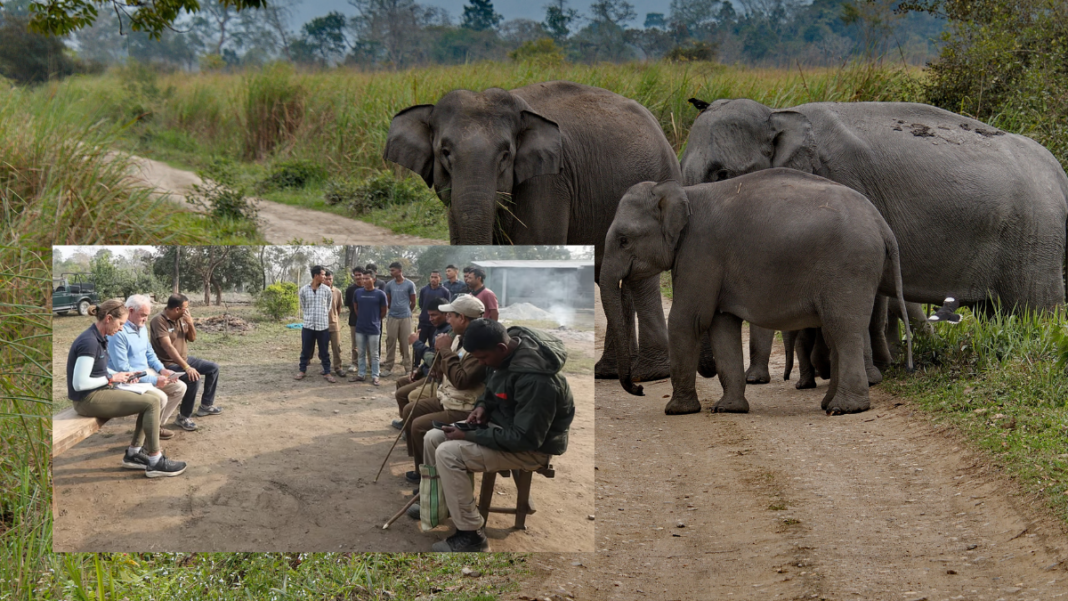
Mahouts (elephant handlers) at Manas National Park and Tiger Reserve in western Assam are being trained to work with elephants without pain or force, as part of an international programme aimed at improving the welfare of captive Asian elephants.
The four-day training, held from February 1 to 4, 2026, brought together specialists from Australia’s H-ELP Foundation, teams from Kaziranga National Park, and the Wildlife Trust of India (WTI). The initiative took place at Manas, an 850-square-kilometre UNESCO World Heritage Site that borders Bhutan and lies about 130 kilometres northwest of Guwahati.
Mark Trayling, chairperson of the H-ELP Foundation, said the long-term objective is to create a group of master trainers who can pass on the methods to mahouts across northern India. “Although we come from a country without elephants, Australia and India share strong values in wildlife protection,” he said.
“We both work towards the same goal: giving these animals the best possible life.”
C. Ramesh, Field Director of Manas National Park and Tiger Reserve, told TNIE that the initiative positions Manas as an important contributor to global conservation efforts. “We are proud to be at the forefront of elephant welfare,” he said.
“By adopting world-leading, scientifically backed methods, we are showing how collaboration can deliver kinder and more sustainable outcomes for elephants.”
With nearly one-third of the world’s critically endangered Asian elephant population living in captivity, the programme focused on replacing traditional coercive practices with evidence-based, ethical training methods. The goal was to help mahouts communicate effectively with elephants while reducing stress and risk for both animals and handlers.
Dr Andrew McLean, lead trainer from the H-ELP Foundation, told The Hindu the programme worked closely with a select group of mahouts from Manas and Kaziranga to demonstrate welfare-friendly alternatives to force-based control.
“The emphasis is on positive, pressure-release reinforcement rather than punishment,” Mr McLean said.
“The training follows four steps: a voice command, gentle stick direction, verbal praise such as ‘shabash’, and a food reward. Over time, the aim is to rely mainly on voice commands and hand signals.”
He explained that the approach is particularly valuable during routine veterinary procedures, such as lifting a leg or allowing an inspection, which are essential for elephant health but can be stressful if handled poorly.
Dr Bhaskar Choudhury, a wildlife veterinarian at the WTI-run Centre for Wildlife Rehabilitation and Conservation at Kaziranga, said frustration sometimes led mahouts to resort to force when elephants did not respond quickly. “This training should make a real difference,” Dr Choudhury said.
“Mahouts already share a strong bond with their elephants. These methods help them remain calm and gentle, which ultimately benefits everyone involved.”
According to park officials and trainers, the programme is also about safety. Younger mahouts who participated in the training said it had changed their understanding of how elephants respond to humans.
The programme also aims to address a wider gap in formal training for mahouts. Dr Choudhury noted that with the end of traditional wild elephant capture and training, structured knowledge of captive elephant management has gradually declined.
Support our Journalism
No-nonsense journalism. No paywalls. Whether you’re in Australia, the UK, Canada, the USA, or India, you can support The Australia Today by taking a paid subscription via Patreon or donating via PayPal — and help keep honest, fearless journalism alive.
