

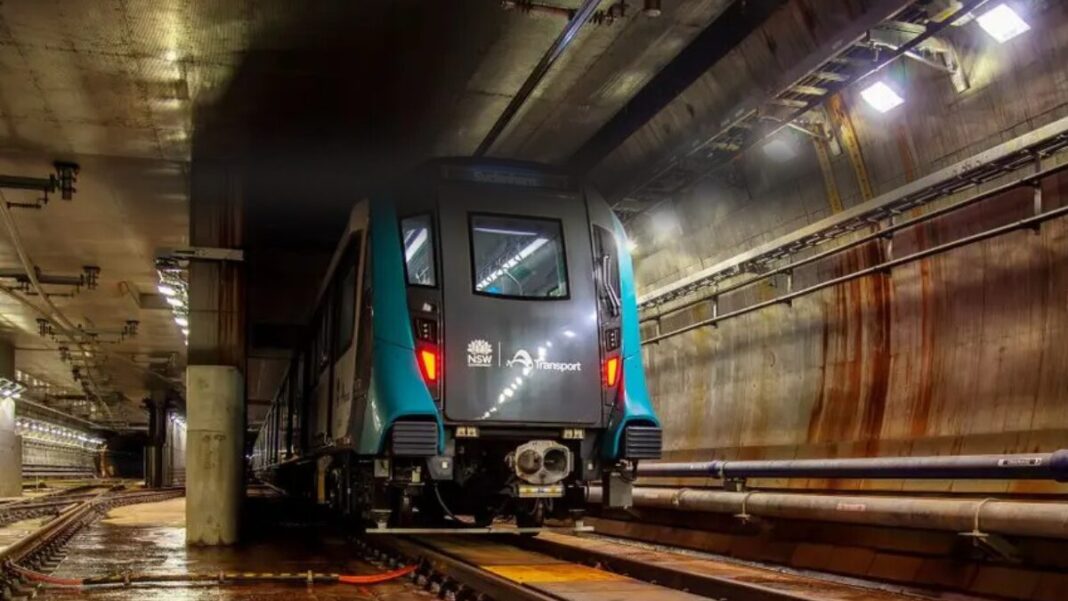
A metro train has, for the first time, travelled the full length of the M1 Metro North West & Bankstown Line from Tallawong to Bankstown, a milestone that brings Sydney’s long-awaited southwest metro extension a major step closer to opening later this year.
The test run covered the entire 66-kilometre route, stopping at all 31 stations and reaching speeds of up to 100km/h on newly built sections of track. For commuters, it offered a tangible preview of a network that will soon deliver a train every four minutes in peak periods — almost doubling services compared with the former T3 Bankstown Line, which ran just eight trains an hour.
Transport Minister John Graham said the successful end-to-end test marked an exciting day for the whole city, but particularly for communities in southwest Sydney that have been waiting to join the metro network. With high-frequency services, he said, the new line would dramatically improve access to jobs and education across Sydney.
The extension is part of the Minns Labor Government’s record $30 billion-a-year infrastructure program and is expected to transform daily travel for thousands of passengers. Once operational, travellers from Bankstown will reach Gadigal Station in about 30 minutes — a 15-minute saving on the old heavy rail journey to Town Hall.
Across the southwest, commuters are set to benefit from substantial time savings, including faster trips from Marrickville to Gadigal, Lakemba to Victoria Cross and Campsie to Macquarie University. Member for Canterbury Sophie Cotsis said the project would better meet the transport needs of the region while opening up new employment opportunities. She noted that, once complete, residents from suburbs such as Wiley Park would be able to reach Central, Gadigal and Barangaroo in under half an hour.
Construction across the corridor is now well advanced, with 79 per cent of work completed. Tiling is largely finished at four stations, while painting and landscaping are under way at most sites. World-leading safety features, including platform screen doors and mechanical gap fillers, have already passed their first round of testing at every station.
Member for Bankstown Jihad Dib acknowledged the disruption caused by the lengthy construction and testing phase, thanking local residents for their patience. He said the payoff would be frequent services and significantly shorter journeys to key destinations such as Martin Place, Barangaroo, Macquarie University and Chatswood.
The project has now entered a critical high-speed testing phase, which requires at least 9,000 hours and 30,000 kilometres of combined testing before the line can open. More than 70 major integration tests will be carried out to ensure trains, signalling and new infrastructure work together safely and reliably.
As part of the final conversion, crews will integrate the southwest extension with the existing metro line — work that will require a series of full and partial closures on the M1 Line. While disruptive, authorities say the shutdowns are essential to complete the work safely within the rail corridor. In January, metro services will not run on the weekends of 17–18 and 24–25 January, with replacement buses operating between Tallawong and Chatswood and Sydney Trains services running between Chatswood and Sydenham.
Member for Summer Hill Jo Haylen said the project had been a long journey for Inner West and Canterbury-Bankstown communities, but the benefits would be substantial. With peak services every four minutes, she said passengers would reach Victoria Cross in just over 20 minutes and Chatswood in under half an hour from Dulwich Hill — improvements that would make public transport faster, easier and more reliable.
The government has again thanked affected communities and metro passengers for their patience as testing continues, with the first full-length run now standing as a clear sign that Sydney’s newest metro link is nearing the finish line.
Support our Journalism
No-nonsense journalism. No paywalls. Whether you’re in Australia, the UK, Canada, the USA, or India, you can support The Australia Today by taking a paid subscription via Patreon or donating via PayPal — and help keep honest, fearless journalism alive.
