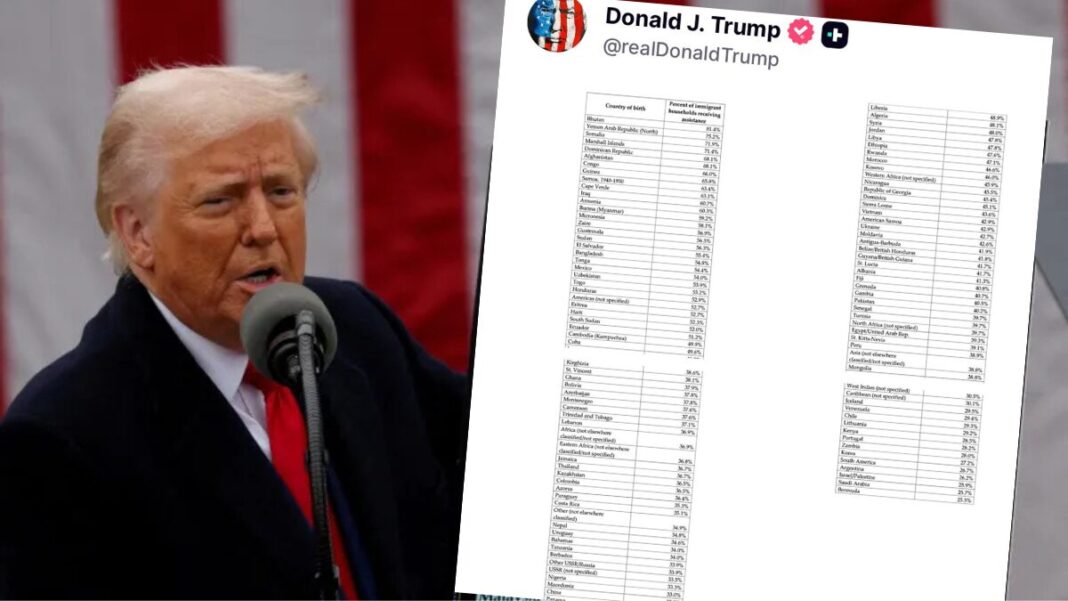
US President Donald Trump has shared a chart on his social media platform Truth Social claiming to show the proportion of immigrant households from different countries receiving welfare or public assistance in the United States, with several Pacific nations ranking high on the list.
The chart, titled Immigrant welfare recipient rates by country of origin, lists about 120 countries and territories and highlights the percentage of immigrant households accessing government assistance based on country of birth.
Bhutan appears at the top, with more than 80 per cent of immigrant households shown as receiving assistance. Trump’s post highlighted figures for countries including Bangladesh, Pakistan, Nepal, China, Israel/Palestine and Ukraine. Notably absent from the list is India.
Several Pacific nations also feature prominently. The Marshall Islands rank among the highest, followed by Samoa, the Federated States of Micronesia and Tonga. American Samoa — an unincorporated US territory — is also listed, along with Fiji further down the chart.
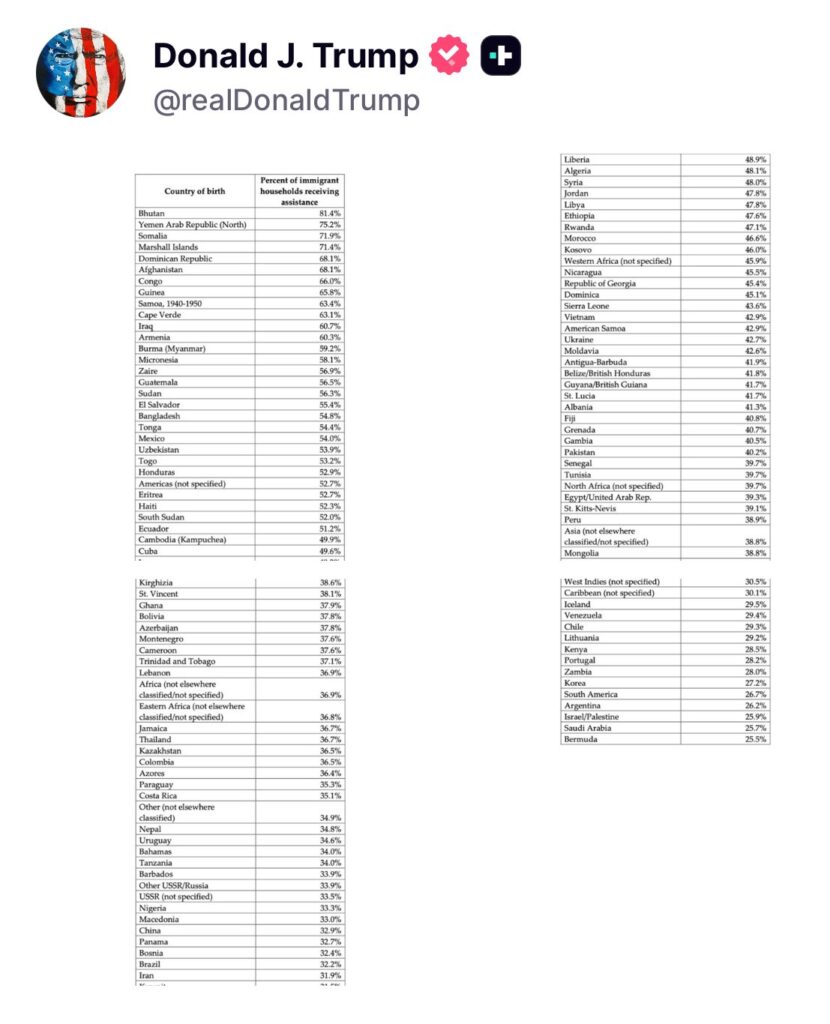
The omission has drawn attention amid broader debate over immigration and welfare use in the US, particularly as Trump continues to push a hardline stance on immigration ahead of the presidential election.
According to the Pew Research Centre, Indian Americans consistently rank among the highest-earning ethnic groups in the United States and have comparatively low reliance on welfare and assistance programmes.
Pew estimates show Indian Americans make up about 21 per cent of the US Asian population, making them the second-largest Asian-origin group in the country. In 2023, the median annual income of Indian-headed households was about US$151,200, well above the median for Asian-headed households overall.
Indian Forest Service officer Parveen Kaswan also weighed into the discussion online, sharing a scatter plot comparing welfare usage and household income among immigrant groups. He said the data clearly showed Indians earning more while relying less on welfare, describing Indian immigrants as “net contributors” to the US economy.
Trump’s chart does not cite a source for the figures, but analysts note that income, education and employment patterns play a significant role in determining welfare uptake. Higher median incomes and lower poverty rates among Indian Americans help explain why India does not appear among countries with higher reported assistance use.
Taken together, the data suggests the chart highlights stark contrasts between immigrant communities — with Pacific nations featuring heavily — while reinforcing the economic profile of Indian Americans as one of high earnings and low dependence on public assistance in the United States.
Support our Journalism
No-nonsense journalism. No paywalls. Whether you’re in Australia, the UK, Canada, the USA, or India, you can support The Australia Today by taking a paid subscription via Patreon or donating via PayPal — and help keep honest, fearless journalism alive.