

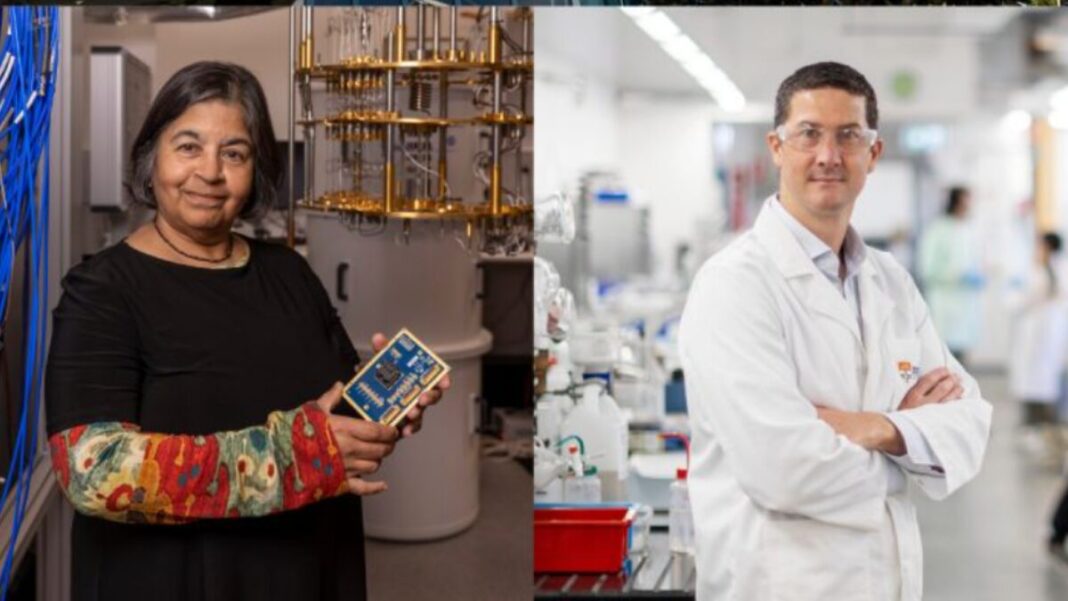
Two University of Sydney–led research initiatives, including a flagship quantum security centre headed by renowned Indian-origin mathematician Prof. Nalini Joshi, have each secured $35 million in federal funding, strengthening Australia’s leadership in frontier science and technology.
The funding, awarded under the Australian Research Council (ARC) Centres of Excellence program, forms part of a $279 million national investment announced in the latest round. The University of Sydney leads the equal-highest number of successful centres nationwide.
Prof. Joshi AO will direct the ARC Centre of Excellence in Mathematics for Quantum Era Security and Trust (MathQuEST), which aims to address the looming breakdown of existing cybersecurity systems in the age of quantum computing while also building trust in artificial intelligence.
A Payne-Scott Professor, Dr Joshi is Chair of Applied Mathematics at the University of Sydney and a past ARC Georgina Sweet Australian Laureate Fellow. Born in Burma and raised in Australia, she completed a BSc (Hons) with the University Medal in applied mathematics at the University of Sydney in 1982, before earning a PhD in computational and applied mathematics from Princeton University in 1987.
Her research spans mathematical methods used to model physical systems across scales—from quantum phenomena to astronomical structures—and has recently expanded into post-quantum cryptography, a key focus of the new centre.
Prof. Joshi’s career has been marked by significant national and international recognition. She was elected a Fellow of the Australian Academy of Science in 2008, awarded the ARC Georgina Sweet Australian Laureate Fellowship in 2012, and named the 150th Anniversary Hardy Fellow of the London Mathematical Society in 2015. In the 2016 Queen’s Birthday Honours, she was appointed an Officer of the Order of Australia for distinguished service to mathematical science and tertiary education.
Beyond her research, Prof. Joshi is widely recognised for her commitment to equity in science. Her Laureate Fellowship included a strong focus on attracting and retaining women in STEM, and she served as the foundation co-chair of the Science in Australia Gender Equity (SAGE) initiative, which now involves dozens of research organisations and universities nationwide.
The second Sydney-led project, the ARC Centre of Excellence for Advanced Peptide and Protein Engineering (CAPE), will be led by Prof. Richard Payne and focuses on the design and manufacture of advanced biomolecules with applications in human health and environmental protection.
Vice-Chancellor and President Prof. Mark Scott AO said the Centres of Excellence exemplify the university’s collaborative ethos.
“The Centres of Excellence are about combining diverse expertise and perspectives to address complex issues for the benefit of all, something deeply ingrained in our values as a university and in our Sydney in 2032 strategy.”
Interim Deputy Vice-Chancellor (Research) Prof. Julie Cairney said the initiatives draw on the university’s multidisciplinary strengths, world-class infrastructure and strong industry and government links.
With applications spanning defence, agriculture, health and industry, MathQuEST is expected to play a critical role in preparing Australia for the technological and security challenges posed by future quantum computers, while training a mathematically skilled, technologically agile workforce for the decades ahead.
Support our Journalism
No-nonsense journalism. No paywalls. Whether you’re in Australia, the UK, Canada, the USA, or India, you can support The Australia Today by taking a paid subscription via Patreon or donating via PayPal — and help keep honest, fearless journalism alive.
