

By Devlopment Policy Centre and World Bank
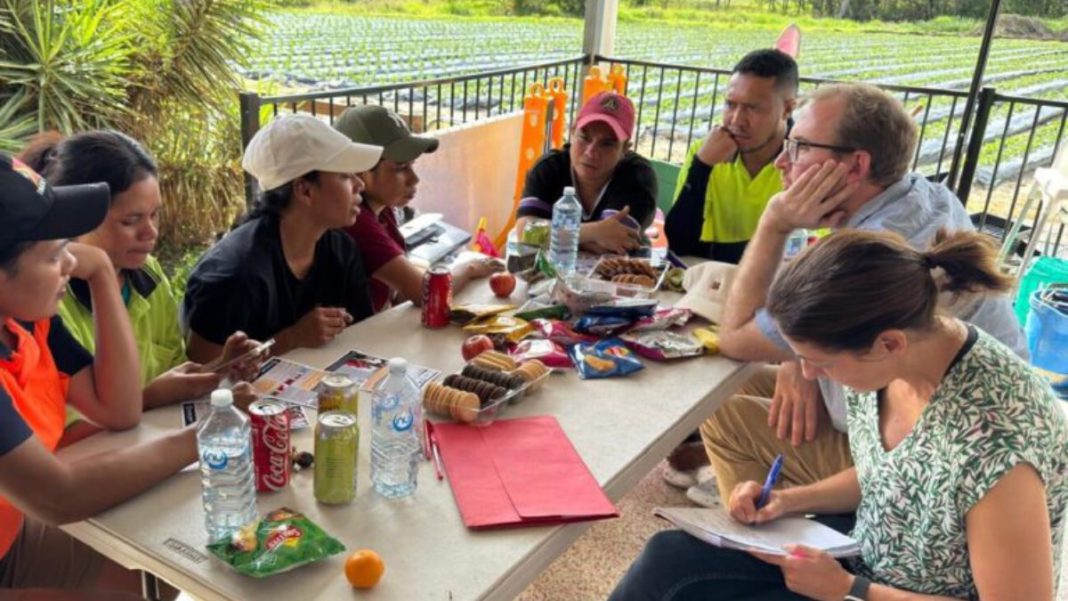
The Development Policy Centre and the World Bank recently carried out consultations in Australia, New Zealand and several Pacific countries to listen to stakeholders involved in Australia’s Pacific Australia Labour Mobility (PALM) scheme and New Zealand’s Recognised Seasonal Employer (RSE) scheme. These consultations inform the design and implementation of the second wave of the Pacific Labour Mobility Survey (PLMS).
While the PALM and RSE schemes share many features, their different settings, while allowing helpful comparative analyses, mean generalisations cannot be made across the two.
In this article, we share insights from our visits to various locations in the worker-receiving countries — Australia and New Zealand. Our stops included Blenheim and Napier in New Zealand as well as Queensland and the Riverina in Australia. We spoke with nearly 200 Pacific workers from Vanuatu, Tonga, Samoa, Fiji, Papua New Guinea and Timor-Leste, and 15 PALM and RSE employers, hearing both workers’ and employers’ perspectives in the same context.
During these consultations, workers reported challenges they sometimes face when working and living overseas. These include limited financial literacy which can impede workers’ understanding of wage rates, payslips, deductions and remittance channels, poor workplace and living conditions and prolonged family separation. These wellbeing concerns are generally the exception rather than the rule. Such concerns have been raised repeatedly over the lifetime of the PALM and RSE schemes, documented carefully in PLMS Wave One, and have prompted a variety of policy changes and additional regulatory measures.
Improvements to workers’ conditions, however, have led to a growing regulatory burden, and associated financial costs, on approved PALM and RSE employers.
As the consultation visits relied on the voluntary participation of employers, we mostly met with medium to large employers who were open to engaging with researchers. Conversations with these employers revealed a deep appreciation for the schemes, a genuine concern for their Pacific workforce and a willingness to invest in workers’ wellbeing.
Many employers have undertaken in-country recruitment themselves, building long-term relationships with workers’ households and communities. Most employ full-time staff dedicated solely to managing the schemes and addressing workers’ needs. Several have introduced, or are exploring, opportunities for formal and informal skills and training. Some have offered services and support beyond the schemes’ requirements, including investments in dedicated health clinics, gyms, sporting facilities and places of worship to support workers’ health and welfare while overseas.
However, even these caring and capable employers face challenges. As one PALM employer joked, they could “spend days talking about the problems”. In Australia, common concerns relate to the increasing complexity of the PALM scheme and rising costs to recruit, mobilise and accommodate PALM workers.
PALM employers must now have accommodation approved by the Department of Employment and Workplace Relations ready before recruitment begins, and the recruitment process itself has stretched to more than double the six-week standard. This not only creates operational challenges but also forces employers to hold empty accommodation for long periods, resulting in high overheads — and unnecessarily empty housing when Australia is in the middle of a housing crisis. Some reporting requirements, such as notifying authorities when workers change transport modes or move between approved houses, are widely viewed as adding little value while consuming considerable administrative resources.
For some PALM horticulture employers, the seasonal nature of the work makes it difficult to consistently meet the minimum requirement to pay for 120 hours of work over four weeks, and they have adjusted their recruitment to better reflect the natural ebbs and flows of their businesses. Concerns were also raised about the duplicative, redundant and complicated nature of the two welfare floors they must now comply with (minimum hours over four weeks and minimum weekly take-home pay) when it comes to workforce planning and reporting.
Worker disengagement in Australia is another concern. Although the disengagement rate has fallen substantially in recent periods, the issue still warrants attention as even moderate levels of disengagement impose significant costs on employers and the sizeable cohort of already-disengaged workers continues to pose reputational risks for the scheme. In both Queensland and the Riverina, disengagement has been widespread. What is striking is the extent of the networks between current PALM workers and those who have disengaged. The incentives to disengage are wide-ranging, and can include the lure of being paid cash-in-hand by rogue employers, with no tax obligations, or encouragement to apply for asylum which results in the issuance of a bridging visa, legal work rights and access to Medicare.
Despite these incentives, most PALM workers remain committed to their jobs, motivated by a strong sense of responsibility to their families and communities and a belief in the long-term benefits of remaining in the scheme. For employers, the loss of workers who choose to disengage is not only frustrating, but also a stark reminder of their limited ability to prevent worker departures. Yet, many employers accept and respect that this is a rational choice for some workers and just do their best to keep them happy and engaged.
During consultation visits in New Zealand, RSE employers generally expressed fewer frustrations about how the scheme is administered. But they share with their Australian counterparts concerns about the growing regulatory burden of RSE participation and associated costs of compliance. In a horticultural sector that is export-driven, with tight profit margins and limited ability to pass costs onto overseas consumers, rising RSE operational costs are a significant challenge.
A common theme during the consultations was the need to strike a careful balance between tighter government regulations, increased compliance and oversight to protect workers’ rights and welfare, and ensuring participation in the PALM and RSE schemes remains cost effective and financially viable for approved employers.
In response to rising scheme costs, approved employers under both schemes are considering, or already working towards, reducing their reliance on PALM and RSE labour and diversifying to other sources, including backpackers, other temporary migrants and permanent migrants, as well as sponsorship options for their PALM workers outside the scheme. Most of these changes have direct implications for workers, many of whom have expressed concerns about reduced working hours and uncertainty over future participation in the schemes. Fundamentally, both the PALM and RSE schemes are employer driven; without employer demand for Pacific labour, the schemes would cease to exist.
Given all the above, the PLMS Wave Two has an important role to play in providing robust evidence about the experiences of workers and their families, and rigorous statistics on how things have changed following recent reforms undertaken after Wave One was completed. This evidence can be used to help inform future PALM and RSE policy settings and ensure the policies continue to deliver positive outcomes.
This oped was first published on the Devpolicy Blog and is republished here with the kind permission of the editor(s). The Devpolicy Blog is based at the Development Policy Centre, Crawford School of Public Policy, College of Law, Governance and Policy, The Australian National University. Posts on the Devpolicy Blog are licensed under a Creative Commons Attribution-NonCommercial-ShareAlike 4.0 International License unless otherwise noted.
Disclosure: This research was supported by funding from the Australian Department of Foreign Affairs and Trade. The views expressed are those of the authors only.
Contributing Authors: The authors who contributed to this article are Ryan Edwards, Charlotte Bedford and Huiyuan Liu from the Development Policy Centre, and Thomas Walker, Dung Doan, Trang Luu and Robyn Kingston from the World Bank.
Support our Journalism
No-nonsense journalism. No paywalls. Whether you’re in Australia, the UK, Canada, the USA, or India, you can support The Australia Today by taking a paid subscription via Patreon or donating via PayPal — and help keep honest, fearless journalism alive.
