

By Raoul Galea and Worakamon Chardcharoen
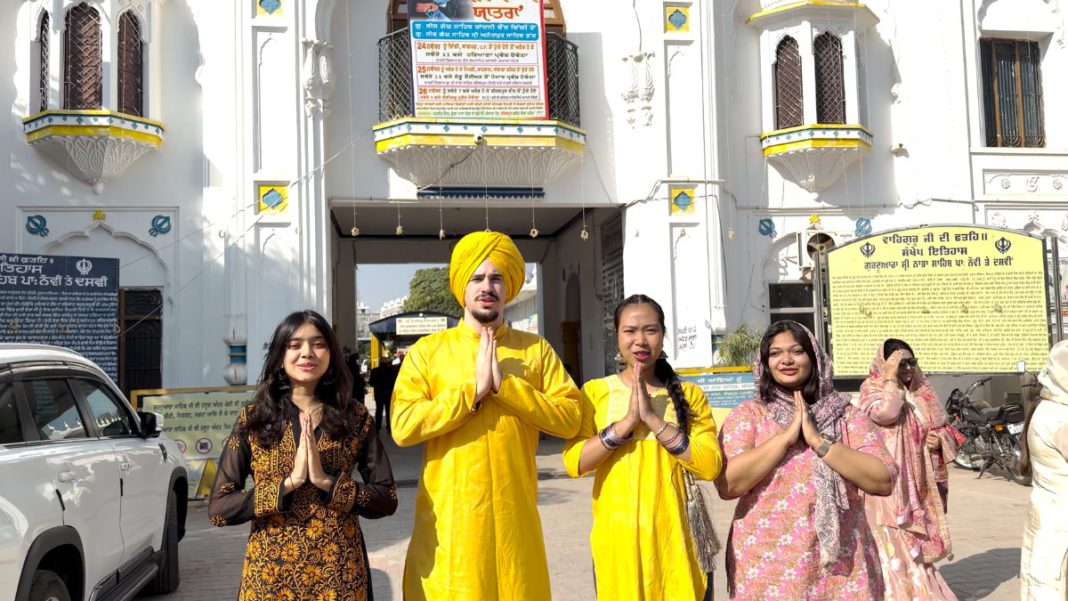
We arrived at Chitkara University tired from our long journey from Noida, Delhi, ready to begin the second half of our two-week study tour in India. The tour group comprised two academics and 12 students from Western Sydney University. Despite the fatigue, we were excited to explore unfamiliar places, meet new people, and learn about Sikhism through real experiences and personal interactions.
We knew extraordinarily little about the faith before arriving, but it was something we were eager to understand, especially as the Indian diaspora continues to grow in Australia and worldwide. Our journey into Sikhism took us to a local Gurudwara, Nabha Sahib in Zirakpur, as well as to the Golden Temple (Sri Harmandir Sahib), the most significant pilgrimage site for Sikhs.
We travelled to the Gurudwara by auto-rickshaw, weaving through traffic and experiencing heart-stopping moments as the driver manoeuvred through a maze of humans, all forms of traffic, and animals moving in all directions.
Our counterparts from Chitkara University translated from Punjabi and Hindi into English, explained customs, traditions, and behaviours, and supported us throughout the experience. At the entrance, the guards asked why we had come. They quickly welcomed us, offering chai and permitting us to film. Their warmth made us feel at home, reflecting the deep significance of equality, community, and service, which form the core of Sikhism.
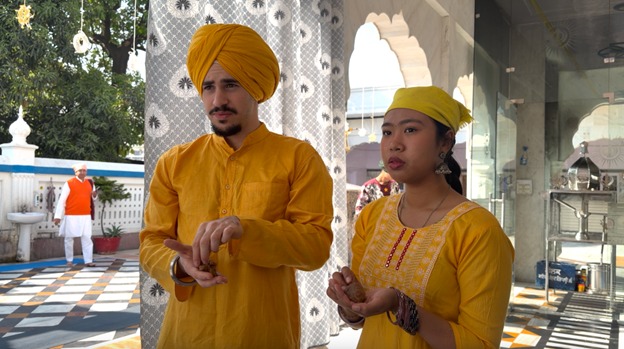
I dressed up for this life-changing experience by wearing a turban and a traditional kurta. My colleague wore a matching yellow salwar kameez. We walked barefoot through the cleansing water, as if crossing a fast-flowing river, before entering the Takhat, the Guru’s Throne. We bowed in respect and placed a small donation into the ‘Golak’ and prayed in front of the Darbar Sahib, where the Guru Granth Sahib is kept.
Upon exiting, we received Kada Prasad, a sweet blend of ghee, wheat flour, and sugar. The serving of this and other foods symbolises seva, a service which has become a universal symbol of Sikhism, where there is no expectation of a return gesture.
This spirit of giving and not receiving became even clearer when we visited the Langar Hall and shared prasad, a communal meal served to all. Eating side-by-side with friends and strangers, we felt a grounding sense of peace, gratitude, and connection.
We left the Gurudwara feeling calm, humbled, and deeply appreciative of the kindness and love we had been shown.
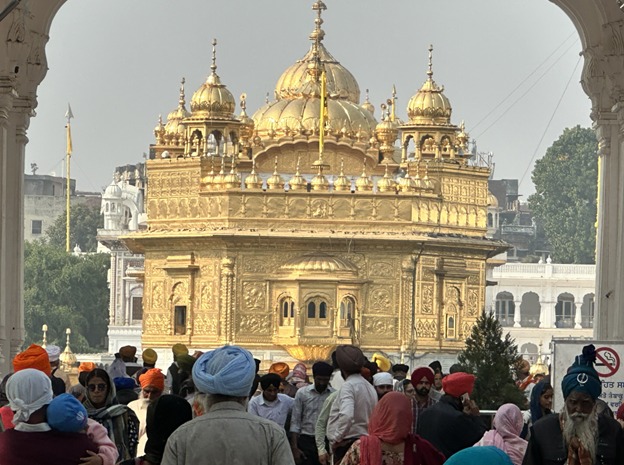
The next day, we travelled four hours north to the Golden Temple with our full group and our guide, Associate Professor Ripudaman Singh from Chitkara. The process was much the same — covering our heads and entering with clean hands and feet.
This visit felt similar in process, but the difference was the overwhelming scale and beauty of the site. Thousands of people entered the grounds alongside us, many bathing, praying, drinking the holy water, sitting in quiet spaces, tuning in to the sermons, and moving through the complex with a spring in their step.
We chose not to join the hour-long queue to enter the Golden Temple itself, where many pilgrims immerse themselves in the surrounding pool as an act of devotion. Instead, we entered the Gurudwara where the Guru Granth Sahib is kept.
Dr Ripudaman explained that in Sikhism, God is understood as Ik Onkar — one universal, formless, timeless creator who is present in all things and beyond physical attributes. Sikhs believe God is not male or female and cannot be represented through images or idols. This understanding comes directly from the Guru Granth Sahib.
The scale of the Langar Hall was once again beyond anything we had imagined. Despite masses of people finding a spot to sit and be served, lunch was incredibly orderly. Regardless of status or belief, everyone sat side by side, eating together in harmony.
The generosity again was astonishing; the volunteers came by many times offering seconds, thirds, and fourths. Their kindness challenged our assumptions about charity and compassion in our own countries.
Authors: Raoul Galea and Worakamon Chardcharoen (in collaboration with Journalism and Mass Communication students from Chitkara University)
Disclaimer: The opinions expressed within this article are the author’s personal opinions. The Australia Today is not responsible for the accuracy, completeness, suitability, or validity of any information in this article. The information, facts, or opinions appearing in the article do not reflect the views of The Australia Today, and The Australia Today News does not assume any responsibility or liability for the same.
Support our Journalism
No-nonsense journalism. No paywalls. Whether you’re in Australia, the UK, Canada, the USA, or India, you can support The Australia Today by taking a paid subscription via Patreon or donating via PayPal — and help keep honest, fearless journalism alive.
