

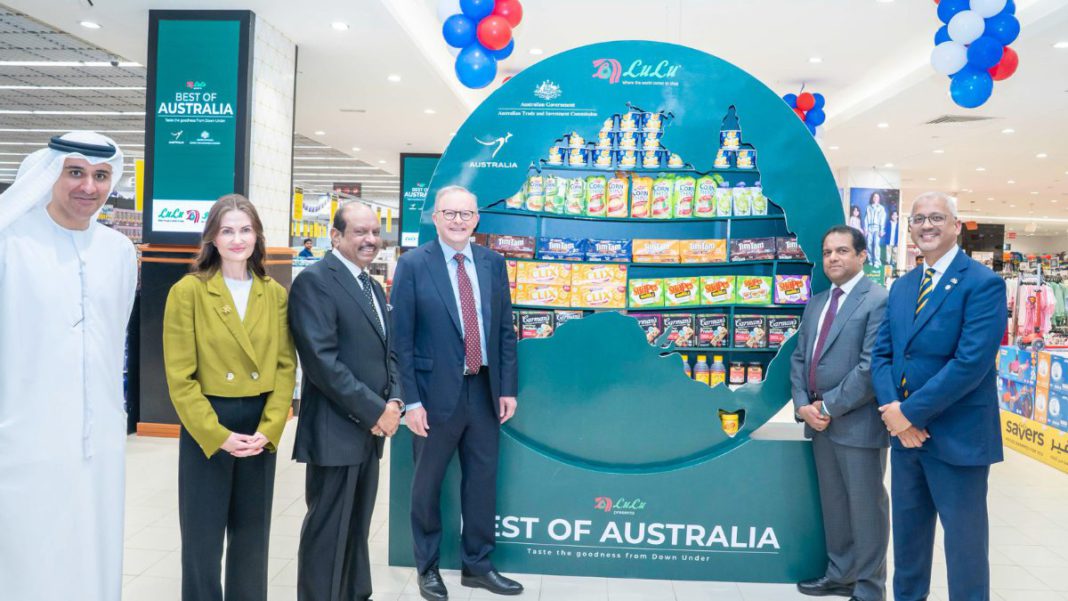
When Prime Minister Anthony Albanese stopped in Abu Dhabi on his way back from a whirlwind diplomatic tour, he wasn’t only talking trade and tariffs. He was extending a personal invitation to one of the world’s most influential migrant entrepreneurs — Indian-origin billionaire M.A. Yusuff Ali — to bring his LuLu Hypermarket chain to Australia.
“I have encouraged him to come to Australia as well. We need more competition in the supermarket sector,” Albanese told reporters, signalling that the government sees the Emirati-based retail giant as a potential disruptor to the Coles-Woolworths duopoly.
For Yusuff Ali, 69, the idea of expanding into Australia is just the latest chapter in a remarkable migrant success story.
Born in a small village in Kerala, India, Yusuff Ali left for Abu Dhabi in 1973 to help his uncle run a modest distribution business. Within decades, he transformed that venture into LuLu Group International — a global retail empire with more than 260 hypermarkets and shopping malls across the Gulf, Asia, Europe, and the United States. Today, LuLu employs more than 70,000 people from 46 nations and generates annual revenues exceeding US$8 billion.
Yusuff Ali’s hypermarkets are known for their scale and cultural sensitivity, stocking everything from Indian spices and British tea to Filipino snacks and halal-certified Australian meat. That diversity of products has made LuLu a shopping destination for millions of expatriates in the Gulf and could resonate strongly with Australia’s multicultural consumers.
Albanese himself noted that the company already sources directly from Australian farmers, including mango and orange growers and meat exporters supplying halal-certified products to Gulf markets.
Unlike many global tycoons, Yusuff Ali is recognised as much for his philanthropy as for his business empire. He has contributed to hospitals, schools, and disaster relief efforts across India and the Gulf, and has been honoured with prestigious awards including the UAE’s highest civilian award, Bahrain’s Wessam Al Bahrain, the Queen’s Award for Enterprise, and India’s Padma Shri.
In 2024, Yusuff Ali listed LuLu Retail on the Abu Dhabi Stock Exchange, raising US$1.7 billion in one of the Gulf’s biggest retail IPOs. His investments also include the Waldorf Astoria in Scotland, London’s Great Scotland Yard Hotel, and a minority stake in Cochin International Airport, the world’s first fully solar-powered airport.
For Australia, Yusuff Ali’s entry could mean more than just another supermarket chain. His arrival would inject long-awaited competition into a sector that has been dominated by two players for decades. Aldi’s arrival in 2001 reshaped grocery shopping habits, and industry experts believe LuLu could spark a similar disruption.
Albanese’s invitation also comes as a new free trade agreement with the UAE removes tariffs on nearly all Australian exports and opens the door to billions of dollars in Gulf investment through the Emirates’ vast sovereign wealth funds.
For Yusuff Ali, who began life in modest surroundings in Kerala before rising to become one of the Gulf’s most respected business leaders, expansion into Australia would be both a business move and a symbolic milestone. His story reflects the resilience and ambition of the migrant journey, creating opportunities not just for himself but for tens of thousands of employees worldwide.
If LuLu does set up shop in Australia, local shoppers may soon find themselves with a new choice at the checkout — one shaped by the determination of a young man from India who became the Gulf’s retail king.
Support our Journalism
No-nonsense journalism. No paywalls. Whether you’re in Australia, the UK, Canada, the USA, or India, you can support The Australia Today by taking a paid subscription via Patreon or donating via PayPal — and help keep honest, fearless journalism alive.
