

By Om Prakash Dwivedi
In an interesting anecdote, a German officer once visited the Spanish artist, Pablo Picasso, where he saw his famous painting, Guernica. Seeing the painting that reflected the suffering and chaos caused during the Spanish Civil War, the officer astonishingly asked Picasso, “Did you do this?” And Picasso responded, “No, you did this.”
This failure to recognise the true cause of the chaos can be largely attributed to the selective amnesia of many of our ideologues, for whom truth is not a matter of concern. What matters most is the causation of the problem, which can be conveniently pinned down to a particular ideology or a group, because the imaginational stretch has lost its rigour. And because every problem must be wedded to a single idea. This is exactly what we find in a recent editorial, “When a Poet is Cancelled,” penned by the former Delhi Lt. Governor, Najeeb Jung, published in The Indian Express on 18th September 2025.
The West Bengal Urdu Academy had cancelled a literary event in Kolkata, which was to feature the renowned Urdu writer and poet, Javed Akhtar. As we are aware, Akhtar is well known for his broadside statements on all types of fundamentalism, including Islamic fundamentalism. He has often been accused of not being a patriotic spokesperson for the Muslims. Citing such reasons, the event was called off, thus depriving the audience of a sterling performance. This does immeasurable injustice to his creative reputation because the organisers deliberately failed to see that Akhtar has always been against any kind of radicalism.
But then comes another version of selective amnesia. Najeeb Jung demonstrates a kind of intellectual feebleness by narrowing down this episode to the recent meeting between the Muslim clerics and the RSS. He asserts, “The Kolkata episode comes against the backdrop of some individuals, Muslim clerics, reaching out to the Hindu community, and the RSS Chief coming forward to meet them.” He goes on to suggest, “Therefore, when an academy funded by a secular state acts as if only one theological reading confers the right to share a stage, it reduces Urdu’s cosmopolitan soul and makes the tent smaller for community.” In the entire article, he tries his best to evade the major cause behind this event. Even when he comes very close to that source, it is only in the form of a conjunction: “The immediate fallout of this incident is an embarrassment for Muslims in India, Muslims in West Bengal, and Muslims, and for the government of West Bengal that let this happen.”
The dexterity with which he avoids using a certain name is an art of amnesia, as it is to link all the Muslim problems to the RSS. It is a reflection that ideological certitudes are more vital than commonsensical convergences. It also reflects a breathtaking insensitivity toward epistemic justice. One can say that selective amnesia has no cure because it is often dogmatic and resolutely averse to seeing the other side. In politics, selective amnesia is a war with oneself, with one’s set-in-stone ideology, because one refuses to see the Otherness, not only of one’s own but also of the other. The Other, then, becomes a perennial evil because the hyper self has divorced itself from the Other. This internalisation of amnesia is more pervasive in most of our demagogues, in our religious leaders, and of course, in the language of the capital.
But I am not going to talk about the capital perversion here. What struck me while reading this recent editorial was a sense of extremity and fanatical disavowal that only demonstrates intellectual feebleness. Both the syntax and semantics of the editorial singularly are stoked with a fundamental problem, which is to blame the right wing for all the wrongdoings. This repetitive stoking then assumes the shape of a Goebbelsian truth: “The historians all along have been adopting a Goebbelsian technique that if you keep repeating a lie a thousand times it will become the truth.” The truth becomes subservient to ideological stubbornness because the truth itself becomes authoritative and also self-serving in nature.
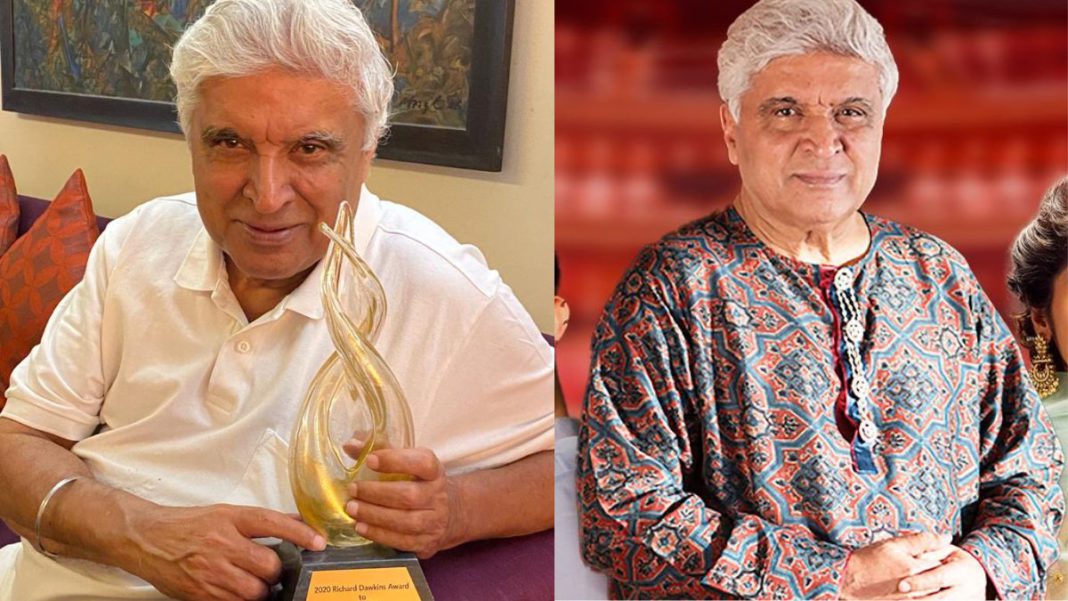
Javed Akhtar’s creativity should not be linked to any religion or to any party. His achievements are far too many to be restricted to any one religion. Who is afraid of Javed Akhtar? That should be the major question that needs to be investigated in this eulogisation and legitimisation of cancel culture in West Bengal. As Akhtar brilliantly sums up in one of his couplets: Kabhi jo khwab tha woh paa liya hai, magar jo kho gayi woh cheez kya thi.
Support our Journalism
No-nonsense journalism. No paywalls. Whether you’re in Australia, the UK, Canada, the USA, or India, you can support The Australia Today by taking a paid subscription via Patreon or donating via PayPal — and help keep honest, fearless journalism alive.
