

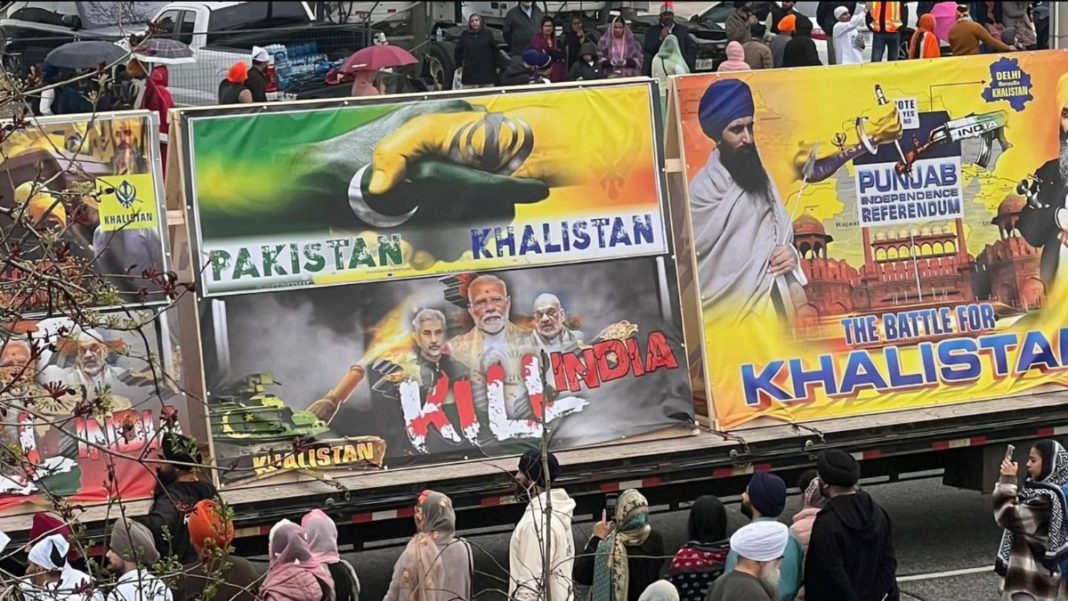
Canada has taken a decisive step in acknowledging what India has long warned about: the presence and operations of Khalistani extremist groups on its soil. The 2025 Assessment of Money Laundering and Terrorist Financing Risks categorically identifies these groups as national security threats, marking a pivotal shift in Ottawa’s counterterrorism strategy.
The 2025 report highlights that these groups continue to operate from within Canada, raising funds, spreading propaganda, and planning violent acts targeting India.
“Khalistani extremist groups supporting violent means to establish an independent state within Punjab, India are suspected of raising funds in a number of countries, including Canada.”
While their fundraising networks have shrunk from earlier decades, the report nobserves that these groups continue to exploit diaspora communities and non-profit organisations for propaganda and financial mobilisation.
For the first time, Canada has officially acknowledged that banned extremist groups such as Babbar Khalsa International and the International Sikh Youth Federation remain active in promoting separatism and violence. The report underscores that while their activities are aimed primarily at India, they carry implications for Canadian national security and foreign relations.
This is not an isolated move. The shift builds on the 2024 annual report of the Canadian Security Intelligence Service (CSIS), tabled in Parliament immediately after Prime Ministers Narendra Modi and Mark Carney held breakthrough talks at the G7 Summit in Alberta. That report bluntly stated:
“Canada-based Khalistani extremists (CBKEs) continue to pose a national security threat to Canada and Canadian interests.”
Crucially, it was the first time the Canadian government described Khalistan supporters operating within its borders as “extremists.” For decades, India has raised concerns about Canada providing a safe haven to such elements, and the new recognition signals a diplomatic breakthrough.
CSIS also confronted Canada’s own painful history of complacency. Reflecting on the 1985 Air India bombing, which killed 329 people, the report admitted:
“In 1985, Canada-based extremists planted and detonated a bomb on Air India Flight 182, killing all 329 people onboard, the majority being Canadian… The failure to disrupt this event provided several hard lessons for CSIS to learn as a young security intelligence service.”
That tragedy remains the deadliest terrorist attack in Canadian history and a lasting reminder of the dangers of allowing extremist ideologies to fester under the guise of free expression.
Earlier this year, Former Canadian Prime Minister Stephen Harper has also urged Ottawa to cut ties with Khalistani extremists. Warning that “those who seek to bring the battles of India’s past to Canada have no place in our political discourse,” Harper stressed that parties cannot hope to build strong relations with India while pandering to separatist groups.
Prime Minister Carney has already signalled his intent to rebuild ties, supported by strong business lobbies eager to expand trade beyond North America.
Canada’s tougher stance is not just about domestic security — it is about repairing credibility with India, a nation it now recognises as indispensable in a volatile world. With the United States under strain from trade wars and China’s aggression, Canada cannot afford to alienate a democratic partner with whom it shares values and people-to-people ties.
This is where Australia and other Five Eyes intelligence partners come in. Canada has finally drawn a red line between free expression and violent extremism — and the rest must follow.
As per CSIS reports, Khalistani extremists do not respect borders, they exploit global financial systems, charitable networks, asylum route, and diaspora politics. By naming and treating them as a serious threat, Ottawa has created the space for collective action.
Australia, the UK, New Zealand, and the US must now align with Canada to ensure that Khalistani extremist fundraising and propaganda networks are dismantled across all jurisdictions. Joint monitoring of suspicious non-profit activities, intelligence sharing, and decisive political distancing from separatist lobbies are vital steps.
For too long, Khalistani extremism has been treated as an “Indian issue.” Canada’s recognition shows it is a global security issue. If Five Eyes democracies truly believe in safeguarding pluralism and protecting their diverse communities, they must act together. Australia, with its growing Indian diaspora and deepening strategic ties with New Delhi, is well placed to lead this collective effort.
Canada has broken the silence. Now it is time for its allies — Australia included — to stand firm and follow suit.
Support our Journalism
No-nonsense journalism. No paywalls. Whether you’re in Australia, the UK, Canada, the USA, or India, you can support The Australia Today by taking a paid subscription via Patreon or donating via PayPal — and help keep honest, fearless journalism alive.
