

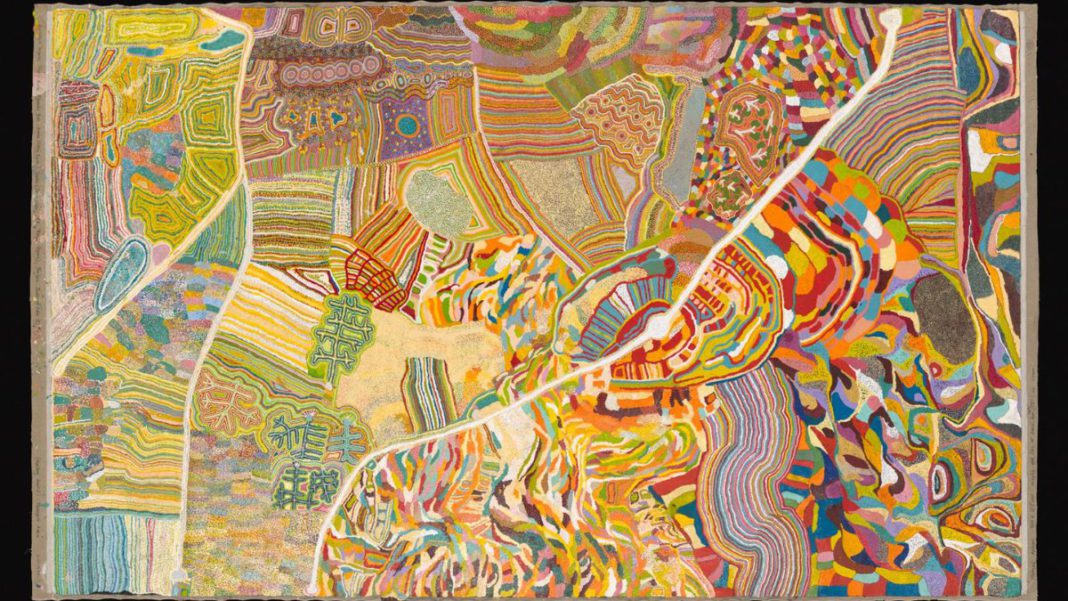
When visitors step into the Humayun’s Tomb World Heritage Site Museum in New Delhi on 22 November, they will be stepping into one of Australia’s most ancient and enduring stories—an epic tale of creation, pursuit and survival that has travelled across deserts, continents and generations.
For the first time, ‘Songlines: Tracking the Seven Sisters,’ the National Museum of Australia’s internationally acclaimed exhibition, will open in India.
More than an art exhibition, Songlines is a monumental cultural narrative that has taken years of collaboration with Aboriginal custodians to assemble, and its arrival in New Delhi marks a milestone in Australia–India cultural exchange.
The Seven Sisters story, shared across Western and Central Desert Country, follows a group of Ancestral women as they flee a powerful, shape-shifting sorcerer. Etched into the land through rock formations, waterholes and ceremonial sites—and mirrored in the night sky through Orion and the Pleiades—this narrative has been sung, danced and passed down for thousands of years.
In the exhibition, it unfolds through nearly 300 paintings, objects, performances and multimedia experiences, guiding visitors along the Sisters’ path as though travelling with them.
Dr Jilda Andrews, Deputy Director First Nations at the National Museum of Australia, describes songlines as “the connective threads that vein our Country,” explaining that they are imprinted across the landscape and recalled through story, song, dance and ceremony.
Bringing these stories to India, she says, creates a cultural dialogue rooted in deep time and shared understandings of land and ancestry.
The exhibition grew from an urgent request by Aṉangu elders to help restore their fragmented Seven Sisters knowledge.
Over seven years, curators and community leaders journeyed across APY, Ngaanyatjarra and Martu lands, recording stories and artworks in a process designed to keep control and authority with the custodians themselves.
Younger community members joined the process, transforming the project into a living bridge between generations.
Much of the material gathered is now part of the National Historical Collection and the Indigenous-managed digital archive Aṟa Irititja in Alice Springs.
A standout feature of the travelling exhibition is the DomeLab, the world’s highest-resolution mobile dome, which surrounds visitors with images from Seven Sisters sites including the remote rock art of Cave Hill in South Australia. Beneath the seven-metre domed ceiling, audiences are transported to desert Country, watching the transit of the constellations and the unfolding of animated artworks that trace the Sisters’ journey.
For Australia, bringing Songlines to India represents a deepening of cultural links with a country whose civilisational heritage also stretches back millennia.
National Museum of Australia Director Katherine McMahon says that after successful tours in Europe, showcasing the work in India “brings Australia’s cultural treasures closer to home,” noting the longstanding connections between the two ancient cultures.
Kiran Nadar, Founder and Chairperson of KNMA, describes the exhibition as an opportunity for Indian audiences to encounter Indigenous Australian storytelling in ways that transcend geography and time, blending cutting-edge technology with ancient wisdom.
Australian High Commissioner to India Phillip Green OAM says the exhibition reflects the Australian Government’s commitment to elevating First Nations voices internationally, emphasising that the Seven Sisters saga is “an epic narrative of the Australian continent” and a cornerstone of the nation’s cultural heritage.
Having captivated audiences in Canberra, Perth, Plymouth, Berlin, Paris and Finland, Songlines: Tracking the Seven Sisters will open at the Humayun’s Tomb World Heritage Site Museum on 22 November 2025 and run until 1 March 2026, inviting visitors in India to walk pathways that have shaped Australia for more than 65,000 years.
Support our Journalism
No-nonsense journalism. No paywalls. Whether you’re in Australia, the UK, Canada, the USA, or India, you can support The Australia Today by taking a paid subscription via Patreon or donating via PayPal — and help keep honest, fearless journalism alive.
